

The Space Shuttle Endeavour hangs suspended in the Samuel Oschin Pavilion, her heat-scarred tiles bearing witness to 25 missions beyond Earth’s atmosphere. Visitors crane their necks upward, transfixed by the 122-foot-long orbiter that once hurtled through space at 17,500 miles per hour. This is no replica, no artist’s interpretation. This is the real thing—a spacecraft that logged 122 million miles and orbited Earth 4,671 times before finding her final home in Los Angeles.
The California Science Center stands as one of the West Coast’s premier scientific institutions, a testament to the enduring human desire to understand the world around us. Located in Exposition Park, adjacent to the University of Southern California and the Natural History Museum of Los Angeles County, this remarkable facility draws over 2.5 million visitors annually, making it one of the most visited museums in the western United States. What began in 1880 as the Museum of History, Science and Art has evolved into a sprawling complex dedicated to making science accessible, engaging, and relevant to everyone who walks through its doors.
A Living Laboratory in Exposition Park
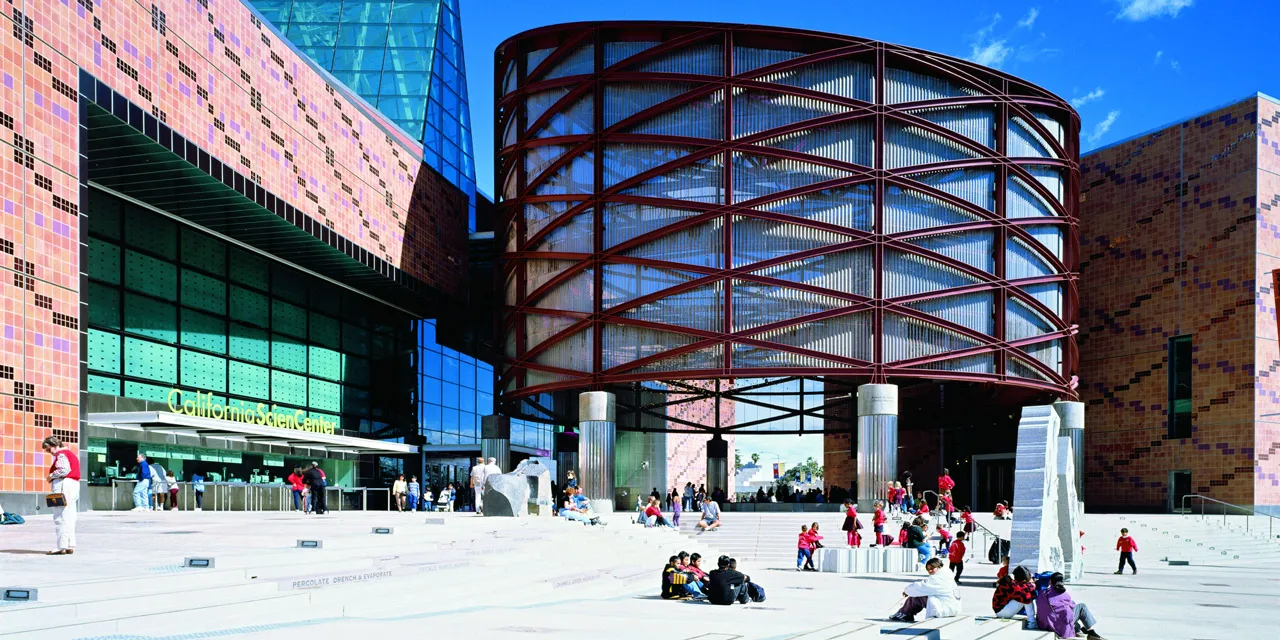
The sprawling 400,000-square-foot facility anchors Exposition Park, a 160-acre cultural and recreational hub that has served Los Angeles since 1872. The Science Center’s architecture itself tells a story of evolution and adaptation. The main building underwent a massive transformation in 1998, reopening with a contemporary design that emphasizes natural light, open spaces, and interactive exhibits. The structure’s clean lines and glass facades create an inviting atmosphere that signals to visitors: this is not your grandmother’s dusty museum.
The institution operates under a philosophy that seems almost radical in an era of rising admission costs and exclusive cultural experiences: admission to the permanent exhibitions is completely free. This commitment to accessibility stems from the center’s founding principle that science education should be available to all, regardless of economic circumstance. While special exhibitions like the Space Shuttle Endeavour require timed-entry tickets, even those are offered free of charge. The model relies on a combination of public funding, private donations, and revenue from IMAX screenings and special programs.
The Permanent Collections: Four Ecosystems of Learning
The California Science Center organizes its permanent exhibitions around four major themed galleries, each designed to explore fundamental questions about our world and our place within it.
Ecosystems: The Web of Life
The Ecosystems gallery occupies 45,000 square feet across two levels and represents one of the most ambitious attempts to recreate diverse natural environments under a single roof. The exhibition doesn’t simply show visitors images or dioramas of distant places—it immerses them in fully functioning ecosystems complete with living organisms.
The centerpiece is a 188,000-gallon kelp forest, the largest living exhibit of its kind in any science center. Giant kelp sways in the current, recreating the underwater forests that line California’s coast. Garibaldi fish dart between the fronds while sea urchins and abalone cling to the rocks below. The kelp itself grows visibly, sometimes adding as much as two feet per day, just as it would in the wild Pacific. Maintaining this living exhibit requires a dedicated team of aquarists who monitor water chemistry, temperature, and the health of every organism daily.
Adjacent to the kelp forest, a flash flood demonstration recreates the sudden, violent water events that shape desert ecosystems. Every hour, 1,200 gallons of water surge through a recreation of a desert wash, demonstrating how rare rainfall events carve canyons and deliver nutrients to seemingly barren landscapes. The exhibit includes authentic specimens from the Mojave Desert, carefully curated to survive in the controlled museum environment.
The river zone features an island ecosystem inhabited by naked mole-rats, those peculiar, nearly hairless rodents that live in underground colonies resembling insect hives more than mammal communities. Visitors can observe these fascinating creatures through tubes and viewing windows, watching as they cooperate in ways that challenge our understanding of mammalian behavior.
World of Life: The Biological Revolution
The World of Life gallery ventures into the microscopic and molecular realms where life’s fundamental processes unfold. This 13,000-square-foot exhibition explores genetics, cell biology, and the cutting-edge science that is revolutionizing medicine and our understanding of ourselves.
The centerpiece is a 50-foot animated high-definition video wall that takes visitors on a journey from the visible world down into the cellular and molecular levels. The experience begins with a chicken’s egg, then zooms inward through multiple orders of magnitude, revealing the intricate machinery inside a single cell, then diving deeper still into the structure of DNA itself.
Interactive stations allow visitors to extract DNA from strawberries using simple household chemicals, making tangible something that typically exists only in textbook illustrations. Another exhibit lets guests compare their physical characteristics with those of family members or strangers, exploring how traits are inherited and how genetic variation manifests in observable ways.
The exhibition doesn’t shy away from contemporary controversies and ethical questions. Displays address genetic engineering, personalized medicine, and the implications of having unprecedented control over the code of life. Rather than prescribing answers, the exhibits provide context and encourage visitors to think critically about these advancing technologies.
Creative World: The Power of Patterns
Creative World occupies 23,000 square feet and might be the most overtly playful of the major galleries. The exhibition explores how humans identify patterns, solve problems, and create innovations. It’s divided into several distinct zones, each addressing different aspects of human creativity and engineering.
The Communication Zone features exhibits on how information moves across time and space, from ancient pictographs to fiber-optic cables. Visitors can experiment with different communication technologies, understanding how each innovation solved particular problems while creating new possibilities and challenges.
The Transportation Zone houses full-size vehicles ranging from bicycles to aircraft, allowing visitors to explore how humans have overcome the challenge of moving themselves and their goods across distances. A bicycle-powered device lets visitors feel exactly how much work it takes to power various appliances, making visceral the abstract concept of energy consumption.
Perhaps most popular is the earthquake simulator, a house structure mounted on hydraulic actuators that recreates the sensation of seismic activity. Visitors step inside and experience simulations of different magnitude earthquakes, gaining immediate appreciation for the forces that periodically reshape California’s landscape.
The Construction Zone features the High Wire Bicycle, where brave visitors can pedal across a wire suspended high above the gallery floor. Safety lines prevent any real danger, but the experience of balancing on a narrow cable provides an unforgettable lesson in physics, center of gravity, and the importance of momentum.
Air and Space: Humanity’s Greatest Leap
The Air and Space gallery chronicles humanity’s conquest of the skies and beyond, from the Wright Brothers’ first flights to the International Space Station. The gallery houses an impressive collection of aircraft and spacecraft, each with its own story of innovation, bravery, and discovery.
A genuine Gemini 11 spacecraft, which orbited Earth 44 times in September 1966, hangs from the ceiling. Unlike many museum specimens, this capsule still bears the scorch marks from reentry, providing a tangible connection to the moment it punched back through Earth’s atmosphere at 25,000 miles per hour.
Interactive exhibits let visitors understand the principles of flight, from the Bernoulli effect that creates lift to the complex engineering required to break the sound barrier. Flight simulators give guests a taste of piloting various aircraft, from nimble fighter jets to lumbering cargo planes.
The Endeavour: A Spacecraft Comes Home
No discussion of the California Science Center can proceed without examining its most famous resident in detail. The Space Shuttle Endeavour arrived in Los Angeles on September 21, 2012, after a final ferry flight atop a modified Boeing 747. But the most remarkable part of her journey remained ahead.
For three days in October 2012, Los Angeles shut down streets to accommodate Endeavour’s 12-mile overland journey from Los Angeles International Airport to the Science Center. The shuttle, mounted on a custom wheeled transporter, crept through city streets at 2 miles per hour. Workers removed traffic lights, temporarily relocated power lines, and even transplanted trees to clear a path wide enough for the orbiter’s 78-foot wingspan.
Nearly 1.5 million people lined the route, cheering and taking photos as the spacecraft inched past. Families camped overnight to secure good viewing spots. The procession stopped periodically to allow schoolchildren to approach and touch the shuttle. It was a civic celebration unlike anything Los Angeles had seen, a collective moment of awe at human achievement.
The shuttle’s current display in the Samuel Oschin Pavilion is temporary. The Science Center is constructing the Samuel Oschin Air and Space Center, a massive new wing scheduled for completion in phases through 2030. When complete, Endeavour will be displayed vertically in launch configuration, mated to an external fuel tank and solid rocket boosters—the only place in the world where visitors will be able to see a complete shuttle “stack” as it appeared on the launch pad.
The new facility will also house the shuttle’s predecessor, the Inspiration4 Crew Dragon capsule from SpaceX’s first all-civilian orbital mission. The juxtaposition will allow visitors to trace the evolution of spacecraft design and contemplate the future of human spaceflight.
IMAX Theater: Science Comes to Life
The seven-story IMAX theater predates the Science Center’s 1998 renovation, having opened in 1984 as one of the first IMAX theaters in the United States. The massive screen measures 87 feet wide by 60 feet tall, creating an immersive viewing experience that standard theaters cannot match.
The theater primarily shows documentary films focused on nature, science, and exploration. Recent offerings have explored the deep ocean, the lives of African wildlife, and the International Space Station. The theater uses dual 4K laser projection, providing unprecedented image clarity and brightness.
The IMAX experience generates crucial revenue that supports the Science Center’s free admission model. Ticket sales help fund operations, educational programs, and the maintenance of living exhibits. In this way, visitors who pay for special experiences subsidize free access for those who cannot afford admission fees.
Educational Mission: Reaching Beyond the Walls
The California Science Center’s physical exhibits represent only a fraction of its educational impact. The institution operates extensive outreach programs serving schools throughout Southern California and beyond.
The Science Center hosts over 250,000 students annually through organized school trips. Educators work with teachers before visits to align museum experiences with curriculum requirements, ensuring that field trips reinforce classroom learning rather than serving merely as entertainment.
The Science Center School program offers intensive, multi-visit experiences for Title I schools—those serving predominantly low-income students. Partner schools receive four visits annually, with lessons building throughout the year. This model allows students to develop deeper relationships with science concepts and museum educators, fostering genuine interest rather than superficial exposure.
For students who can’t visit in person, the Science Center provides distance learning programs. Educators conduct live video sessions directly with classrooms, using museum exhibits and specimens to teach science concepts. During the COVID-19 pandemic, these programs expanded dramatically, serving students not just in California but across the country.
The museum also trains teachers directly, offering professional development workshops on science education techniques. These programs recognize that museum visits constitute only a few hours per year in a student’s education; empowering teachers to deliver effective science instruction throughout the academic year produces far greater impact.
Behind the Scenes: The Unseen Work
Maintaining a world-class science museum requires armies of specialists working behind the scenes. The California Science Center employs over 200 full-time staff members plus hundreds of volunteers and part-time educators.
The living exhibits demand constant attention. Aquarists begin work before the museum opens, testing water chemistry and inspecting every organism for signs of stress or illness. The kelp forest alone requires daily maintenance—removing dead fronds, managing algae growth, ensuring filtration systems function properly. Marine biologists have even successfully bred some species in the exhibits, a testament to how accurately the artificial ecosystems replicate natural conditions.
Conservation specialists continuously assess and preserve the historic artifacts in the collection. Space artifacts present unique challenges—materials exposed to the vacuum of space may degrade unpredictably in Earth’s atmosphere. Temperature and humidity must be carefully controlled to prevent accelerated aging.
The exhibits themselves require constant updates. Science advances rapidly; displays that accurately represented the cutting edge five years ago may now seem dated. The Science Center maintains a dedicated team of exhibit designers, fabricators, and multimedia specialists who refresh and update displays regularly.
Looking Forward: Ambitious Plans
The Samuel Oschin Air and Space Center represents the most ambitious expansion in the Science Center’s history. When complete, the new building will add 200,000 square feet of exhibit space, making the combined facility one of the largest science museums in North America.
Beyond Endeavour’s vertical display, the new wing will feature galleries exploring Earth science, technology, and engineering. An exhibit on climate change will allow visitors to examine data from NASA satellites and understand how scientists monitor planetary systems. Another gallery will focus on the Anthropocene—the current geological epoch defined by human impact on Earth.
The expansion faces significant funding challenges. Total construction costs are estimated at $400 million, requiring extensive fundraising from both public and private sources. The Science Center has secured major donations from aerospace companies, private foundations, and individual donors, but gaps remain. Construction proceeds in phases as funding becomes available, with full completion targeted for 2030.
The institution also plans to enhance its digital presence. Virtual exhibits will allow global audiences to experience the Science Center’s collections remotely. Augmented reality features will overlay additional information onto physical exhibits, customizing experiences for different age groups and knowledge levels.
A Place of Persistent Wonder
On any given weekend, the California Science Center teems with humanity in all its diversity. Parents push strollers while explaining Newton’s laws. Teenagers crowd around the earthquake simulator. School groups in matching T-shirts diligently complete worksheets. Elderly couples examine familiar aircraft, reminiscing about the early space age.
The building contains multitudes—wonder and rigor, entertainment and education, past achievements and future possibilities. It stands as a monument to human curiosity, that persistent drive to understand how things work, to push boundaries, to venture into the unknown.
The institution succeeds because it respects its visitors. It doesn’t condescend or oversimplify. It presents genuine scientific content in accessible ways, trusting that people of all backgrounds can grasp complex concepts when given proper tools and context.
In an era of increasing scientific literacy challenges, when misinformation spreads rapidly and expertise faces skepticism, the California Science Center provides something essential: direct, tactile engagement with scientific principles and authentic artifacts of discovery. Children who touch a moon rock or watch kelp sway in the current develop relationships with science that transcend abstract learning. They understand viscerally that science isn’t just textbooks and tests—it’s spaceships and ecosystems, earthquakes and DNA, human creativity applied to understanding and shaping the world.
The Science Center will continue evolving, adding new exhibits, incorporating new technologies, addressing emerging scientific frontiers. But its core mission remains unchanged since 1880: make science accessible, make it engaging, make it matter. In a city as sprawling and diverse as Los Angeles, the Science Center serves as common ground, a place where everyone—regardless of background, education, or income—can experience the thrill of discovery and contemplate humanity’s greatest achievements and most pressing challenges.
The shuttle Endeavour will soon stand vertical, poised as if ready to launch once more. Visitors will gaze upward at the spacecraft that carried humans to orbit 25 times, and perhaps some will be inspired to pursue the engineering, science, and exploration that will carry humanity forward. That, ultimately, is the California Science Center’s greatest achievement—not the exhibits it houses, but the curiosity it kindles, the questions it provokes, the future scientists and citizens it helps shape.