


There’s a particular kind of place in Southern California that gets swallowed whole by the sprawl — somewhere that used to have a name, used to have a main street, used to have a sense of itself, and then one day woke up to find that the freeway had arrived, the strip malls had multiplied, and nobody could tell where one city ended and another began anymore. Compton merged into the myth. Inglewood became a stadium. Culver City became a tech campus.
Montebello didn’t do that.
Situated about eight miles east of downtown Los Angeles, tucked into a crook of land between the 60 freeway and the 5, Montebello has spent a century being underestimated and another few decades not caring. It is not flashy. It does not have a neighborhood wine bar featured in a Conde Nast Traveler round-up. There is no artisan toast. And yet, once you actually go there — not pass through, not see the sign from the freeway, but actually stop and walk around and eat something and talk to someone — Montebello reveals itself as exactly the kind of place Los Angeles secretly runs on: working-class, deeply Latino, historically rich, quietly proud, and thoroughly alive.
This is its story.
A Name From the Hills
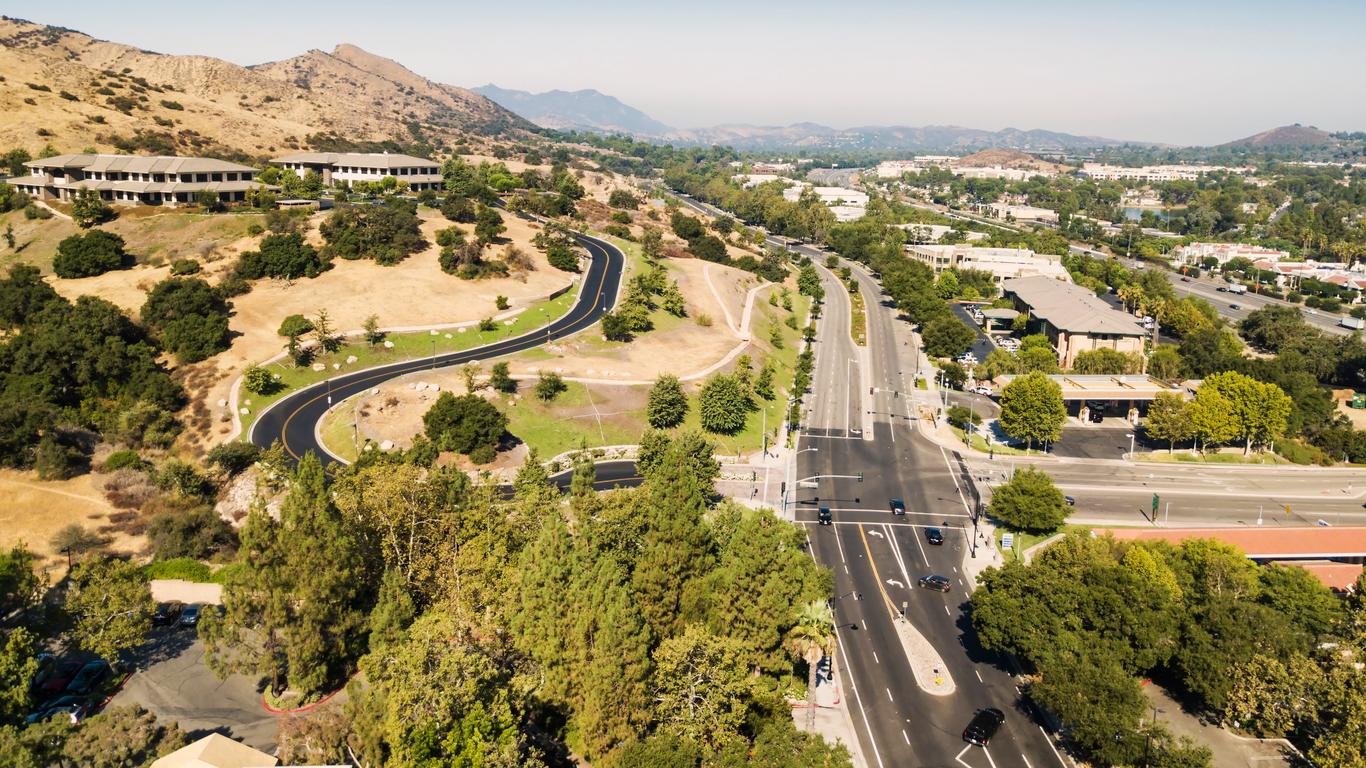
“Montebello” is Italian for “beautiful mountain,” and when you stand at certain elevations in the city’s Montebello Hills area, you understand why someone reached for that phrase back in the early 20th century. The hills roll southwest from the San Gabriel Valley with the easy confidence of terrain that hasn’t been completely tamed. Oil derricks once dotted these slopes — the Montebello Oil Field was one of the most productive in California for much of the 20th century, a fact the city still references with a quiet civic pride in plaques and historical markers.
The geography here shapes everything. Unlike the relentless flatness of much of the eastern LA Basin, Montebello has actual topography, actual elevation changes, actual views. On clear days after rain scrubs the Basin clean, you can see the downtown skyline from the upper reaches of Montebello Hills. On especially good days, you can see the ocean. This is not nothing. In a region where the view is often just the next building, the ability to see distance feels like a form of wealth.
The land was originally part of the Rancho San Antonio land grant, one of the vast Mexican-era ranchos that covered much of what is now Los Angeles County. Before that, it was home to the Tongva people, indigenous Californians who had lived in the region for thousands of years before Spanish colonizers arrived and reorganized the world around missions and cattle. Montebello sits in that layered historical territory — Spanish colonial, Mexican rancho, California statehood, American industrialization — that most of Southern California shares but few cities bother to take seriously as a living part of their identity.
Montebello takes it seriously. Or at least, its history does.
Oil, Oranges, and the 20th Century
For the first few decades of the 20th century, Montebello was agricultural land. Citrus groves covered much of the valley floor; the climate and soil were well-suited to growing oranges and lemons of the kind that once defined California’s export identity. Packing houses processed the fruit. Workers — mostly Mexican and Mexican-American, some Japanese — tended the groves.
Then came oil.
The discovery of significant petroleum deposits in the Montebello Hills during the 1910s and 1920s changed the city’s economic character entirely. The Montebello Oil Field at its peak was producing millions of barrels annually. The landscape shifted: orange groves gave way to pump jacks, dirt roads became paved to carry truck traffic, and the population grew with oil workers and the support industries that followed them. By the time World War II arrived, Montebello had a fully formed blue-collar identity built around extraction, manufacturing, and the kind of physical labor that leaves you tired in the body but clear in the mind about what you’ve accomplished.
The oil eventually declined. The groves had already gone. What remained was a city with a working-class infrastructure, a deep community of Mexican-American families who had been there for generations, and a postwar suburban expansion that brought new residents in waves through the 1950s and 1960s.
Montebello incorporated as a city in 1920, a fact worth noting — it made a deliberate choice not to be absorbed by Los Angeles, not to become a neighborhood, not to give up its own government and its own identity. That decision has reverberated through the city’s entire existence. Everything Montebello is today follows from that original refusal.
The Eastside, Properly Understood
People who live in Montebello often say they’re from “the Eastside,” though Angelenos who live west of the 110 sometimes use that same term to mean something else entirely. There’s a whole geography of Los Angeles that gets collapsed in these casual designations — East LA, the Eastside, East Los — and Montebello occupies a particular place in that landscape that is both specific and relational.
To be from Montebello is to understand yourself as part of a broader Mexican-American cultural geography that stretches from Boyle Heights through East Los Angeles through Montebello and further east into the San Gabriel Valley. The culture here — the food, the music, the religious observances, the family structures, the political sensibilities — did not arrive recently as a wave of gentrification or resettlement. It grew here, organically, over generations.
Walk down Whittier Boulevard, which runs east-west through the city’s commercial center, and you are walking through a street that has been continuously Latino for longer than most Los Angeles neighborhoods have existed in their current form. The carnicerias, the panaderías, the Mexican restaurants serving regional cuisines from Jalisco and Oaxaca and Puebla, the clothing stores with quinceañera dresses in the windows — these are not performing authenticity for outside visitors. They are simply serving the people who live here.
That’s a distinction worth making. In many Los Angeles neighborhoods that have become fashionable for their Latin food scenes or their “authentic” character, there’s a sense of staging, of self-consciousness, of a community existing partly for the gaze of outsiders. Montebello doesn’t have that dynamic, largely because the outsiders haven’t arrived in sufficient numbers to create it. The restaurants on Whittier are cooking what they cook because that’s what the neighborhood wants to eat.
Which means, for anyone willing to look beyond the standard Los Angeles food coverage, it’s an extraordinary place to eat.
The Table in Montebello
Let’s be direct about this: Montebello has some of the best Mexican food in the greater Los Angeles area, and it gets a fraction of the attention it deserves.
The birria situation alone could justify a dedicated day trip. Birria, the slow-cooked goat or beef stew traditionally from Jalisco, has had its national moment — you cannot scroll through a food account without seeing birria tacos with their dark red consommé dripping photogenically. What you see in Montebello is the real version: not the Instagram version, not the food festival version, but the version that’s been made by families from Jalisco communities who settled here and kept cooking what they knew. The consommé is deep and slightly oily and rich in a way that feels genuinely nourishing rather than merely indulgent.
The tamale tradition runs deep here too, especially around Christmastime, when the entire neighborhood smells of masa and chile and lard in ways that would overwhelm a smaller, less confident city. The panadería culture is its own world — Mexican bakeries that open early and close when the pan dulce runs out, full of conchas and cuernos and polvorones in arrangements that are more art installation than pastry display.
Seafood came later but has settled in with force. Mariscos restaurants serving Sinaloan-style preparations — aguachile, ceviche, camarones a la diabla — have proliferated throughout the city, serving a population that may live eight miles from the ocean but has not abandoned its coastal food traditions.
The restaurant that gets the most outside attention is rarely the best one on the block. That’s true in most cities, and particularly true in Montebello, where the best spots often exist without websites, without Instagram presence, without any form of external validation beyond the line out the door every weekend morning.
Montebello Town Center and the American Retail Paradox
There is, in the center of Montebello, a mall.
The Montebello Town Center is a classic Southern California indoor mall of the late 1980s variety: anchor stores, food court, parking structure, the whole familiar configuration. It is not architecturally remarkable. It is not historically significant. It is, in fact, almost perfectly ordinary — the kind of retail infrastructure that was built all over America during a period when the mall was the unchallenged center of suburban commercial life.
But spend any Saturday afternoon there and you’ll notice something that the standard narratives about mall death don’t quite capture: the place is full of people. Not full of shoppers exactly, in the focused retail-therapy sense, but full of families — multigenerational groups using the air-conditioned space the way people have always used public commercial spaces, as a place to be together, to promenade, to eat, to see and be seen.
The food court at Montebello Town Center is a genuinely interesting anthropological document of the community it serves. It’s not the generic chain-food food court of a suburban mall aimed at a homogenous demographic. The vendors there reflect the actual eating habits of Montebello — there is pupusa alongside pizza, there is agua fresca alongside Jamba Juice, there are elote preparations competing with hot dogs.
The mall as a form may be dying in the white-collar imagination, but in communities like Montebello, it was never just a place to buy things. It was public space in a region that doesn’t have very much of it. The fact that it continues to function as that seems worth noting.
The Parks, the Hills, the Breathing Room
Montebello has parks, and they are used.
This sounds like a trivial observation but it isn’t. Parks in Los Angeles exist on a spectrum from the grand (Griffith Park, 4,300 acres of mountain wilderness in the middle of the city) to the vestigial (a half-acre of grass behind a parking lot somewhere in the Valley). Montebello’s parks fall in the middle of that range — functional, neighborhood-scale, genuinely used by the people who live nearby.
Grant Rea Park is the city’s largest, sitting along the south branch of the San Gabriel River with sports fields and picnic areas and the kind of weekend afternoon energy that means families with food and music and children running and adults talking in the shade. It is not a destination park — you don’t drive from the Westside to visit it — but for the people who live near it, it is the park, the place where the neighborhood gathers.
Montebello City Park sits higher, with the hills beginning their rise toward the oil field territory and the views expanding as you climb. There’s a rose garden here, planted and maintained with the kind of civic investment that speaks to a community’s belief in its own future. Rose gardens don’t get planted by cities that have given up on themselves.
The Montebello Hills area — the elevated terrain in the north and east of the city, now largely residential — offers hiking and walking that most visitors don’t know about. The trails are not wild in the way that the Santa Monica Mountains are wild, but they are real and they are elevated and on the right day they show you the whole Basin spread out below with the kind of perspective that makes the city’s complexity suddenly legible.
Civic Pride and Local Government
Montebello runs itself, and this is not an incidental fact.
For a city of 63,000 people to maintain its own municipal government — its own police department, its own public works, its own city council, its own mayor’s office — requires a certain collective investment in the idea of civic identity. Many cities of Montebello’s size in the LA region have given up some or all of these functions to county agencies. Montebello has not.
This comes with complications. Local governance is susceptible to local politics, and Montebello’s civic history includes some turbulent chapters — corruption scandals, political infighting, accusations of mismanagement that led to state oversight. None of this is unique to Montebello; it is, if anything, a familiar pattern in California’s smaller cities where the oversight structures available to larger governments are simply not present.
What it also comes with, though, is accountability. When something is wrong in Montebello — a street that doesn’t get repaired, a park that doesn’t get maintained, a permit that gets delayed — there are specific people whose job it is to fix it and who live in the same city as the people they’re supposed to serve. That proximity creates a form of civic engagement that is genuinely different from what happens in unincorporated communities or in neighborhoods absorbed into large city bureaucracies.
The city has, in recent years, been working through the aftermath of its governance challenges with the kind of methodical institutional self-repair that doesn’t make news but matters enormously to the people who live there.
Education and the Long Game
Montebello Unified School District serves not just Montebello but several surrounding communities, making it one of the larger school districts in the region. Like most urban school districts serving predominantly low-income and working-class communities, MUSD has faced persistent challenges: funding inequities, facilities needs, the accumulated weight of generations of educational underinvestment in Latino communities.
What MUSD has also produced, consistently, is graduates. People who went to Montebello schools and went on to college and careers and lives that expanded beyond what their parents were able to access. This is the unremarkable miracle that happens in schools all over communities like this one — the first-generation college student, the kid who figured out how to leverage community college into a four-year degree, the young person who found in a teacher or a counselor or an extracurricular program the permission to want something larger.
Montebello’s community colleges — East Los Angeles College sits just to the west and serves tens of thousands of Montebello-area students — are part of this infrastructure. California’s community college system is genuinely one of the better pieces of public educational architecture in the country, and for working-class communities in the LA Basin, it has been a ladder for generations.
The Highway Through the Middle
The 60 freeway — the Pomona Freeway — runs directly through Montebello, and you cannot understand the city without understanding what that means.
Freeways did to Los Angeles what railroads did to other American cities, except that the railroad at least created the stations around which downtowns formed. The freeway created movement and severance simultaneously — you could get from the San Gabriel Valley to downtown Los Angeles in minutes, but the road that enabled that transit also cut through existing communities like a blade, dividing neighborhoods from themselves, separating people from parks and schools and family, generating noise and pollution that concentrated in precisely the communities with the least political power to resist.
In Montebello, the 60 runs roughly east-west through the city’s center, close enough to Whittier Boulevard that the commercial corridor exists in its acoustic and atmospheric shadow. The people who live and work along Whittier are breathing air that the freeway has already filtered through the exhaust of a hundred thousand daily commuters.
This is not a small thing. The health impacts of living near freeways in Southern California are well-documented and severe: elevated rates of asthma, cardiovascular disease, and other respiratory conditions correlate closely with proximity to high-traffic roads. Montebello residents, particularly those in lower-income areas nearest the freeway, bear these costs disproportionately.
The activism around these issues — environmental justice organizing, air quality advocacy, the push for green infrastructure and electric transit — has been part of Montebello’s civic landscape for years. It connects to the broader movement for environmental justice in communities of color across Southern California, a movement that is doing serious political and scientific work that tends to get less attention than it deserves.
Across the River: Connections and Context
The San Gabriel River runs along Montebello’s eastern boundary, and across that river is the unincorporated territory of East Los Angeles — not a city, technically, but one of the most densely populated and culturally significant communities in Southern California. The Whittier Narrows Recreation Area sits at the confluence of the San Gabriel and the Rio Hondo, a wedge of green space and wetland that provides habitat in a landscape that doesn’t have much of it.
Montebello’s connections to this eastern LA geography are deep. The demographics of Montebello and East LA blend into each other; the cultural institutions serve both communities; the political organizing that happens in one place echoes in the other. The distinction between “city” and “unincorporated community” that legally separates Montebello from East LA is real in terms of governance but invisible in terms of daily life.
To the north, the city meets the edges of the San Gabriel Valley proper — Pico Rivera, Commerce, the jurisdictional patchwork of southeastern Los Angeles County. To the south and west, it approaches the industrial territory around Vernon and Commerce, the warehouse and light manufacturing districts that are the backbone of the regional economy even as they’re invisible to most of the region’s residents.
Montebello sits in the middle of all this geography as its own thing, distinct from each of its neighbors while connected to all of them.
What Gets Lost in the Coverage
The problem with how places like Montebello tend to get written about — when they get written about at all — is a combination of omission and condescension. Either they don’t exist in the coverage at all (no trend pieces, no restaurant features, no “hidden gem” designations), or they get processed through a poverty-tourism lens that describes everything in terms of hardship and limitation.
Montebello is not a success story in the sense that the phrase usually implies — there is real poverty here, real challenges, real history of disinvestment and inequality. But it is also not a story of failure or absence. It is a city that has been building something for a century, with the materials it was given and the people it had, and what it has built is a genuinely functioning community — not perfectly, not without serious problems, but genuinely.
The 63,000 people who live in Montebello have built a city that has parks and schools and restaurants and churches and community organizations and political institutions and all the infrastructure of a life fully lived. That this city is predominantly Latino and working-class and not oriented toward the consumption or aesthetic preferences of wealthier outside observers does not make it less of a place. It makes it more of one.
How to Actually Go There
If you’re going to visit Montebello — and you should — the move is simple: take the 60 to Garfield Avenue, head north toward Whittier Boulevard, and walk. Walk west along Whittier toward the commercial cluster around the Town Center. Walk east toward the neighborhood blocks where the restaurants have no signage beyond a handwritten menu in the window. Walk into the panadería and buy something. Walk up into the hills in the late afternoon when the light is coming in from the west.
Bring patience. Bring cash. Bring appetite in both the literal and figurative sense. The city will meet you where you are, but it won’t perform for you — it doesn’t have the habit of performing and it hasn’t acquired it.
Montebello is the kind of place that Southern California made in the 20th century and is now busy pretending it didn’t: industrial, immigrant, working-class, persistent. The oil is gone. The citrus groves are memory. The pump jacks are mostly still, though a few still nod slowly on the upper hillsides.
What remains is a city that decided, a hundred years ago, to be a city. It’s still at it.
Montebello is located approximately 8 miles east of downtown Los Angeles. The 60 (Pomona) Freeway and the 5 (Golden State) Freeway both provide access. Public transit via Metro bus lines connects it to downtown LA and surrounding communities.