


The urban sprawl of Los Angeles has a tendency to flatten everything—architecturally, culturally, spiritually. Strip malls blur into taco stands blur into freeway on-ramps in an endless horizontal smear. But there are places where the city remembers it has contours, where elevation creates separation, where the chaos below gives way to something more contemplative. Mount Washington is one such place.
Rising nearly 1,000 feet above the surrounding flatlands of Northeast Los Angeles, this hillside neighborhood has spent more than a century cultivating an identity that runs counter to the relentless development ethos that defines so much of Southern California. It is a place of winding roads and steep stairs, of Victorian cottages perched on impossible slopes, of meditation gardens and Native American artifacts, of views that stretch from the San Gabriel Mountains to the Pacific Ocean. It is, in the parlance of real estate agents who have discovered its appeal, a “best-kept secret”—though the secret has been getting out for some time now.
The Vision of Robert Marsh and the Railway That Built a Neighborhood
The story of Mount Washington as a residential community begins with a developer named Robert Marsh and a problem of access. In the early 1900s, the hills north of downtown Los Angeles remained largely uninhabited. The steep slopes that would later become selling points were initially obstacles—chaparral-covered terrain that discouraged settlement precisely because getting up and down presented such a challenge.
Marsh looked at this problem and saw an opportunity. He had noticed how Angels Flight, the funicular railway that carried passengers up and down Bunker Hill in downtown Los Angeles, had transformed that neighborhood. If a similar conveyance could be built on Mount Washington, the summit could be developed into something desirable—a hilltop retreat for Angelenos seeking respite from the growing city below.
Construction on the Los Angeles and Mount Washington Incline Railway began in October 1908. The railway ran along what would become Avenue 43, climbing a grade as steep as 42 percent over a distance of 3,000 feet. Marsh built a hotel at the summit—a mission-style structure that would serve as both destination and advertisement for the residential lots he planned to sell. The two counterbalanced cable cars were named Florence and Virginia, after the daughters of Marsh and his financial partner, Arthur St. Clair Perry.
When the railway opened on May 24, 1909, it was an immediate attraction. For a nickel, passengers could transfer from the Yellow Car streetcars running along Marmion Way and ascend to the summit, where the Mount Washington Hotel awaited with its panoramic views. The seats in each car were arranged in three tiers so passengers could sit level while enjoying the scenery during the five-minute journey to the top. A conductor accompanied each trip, crossing from the ascending car to the descending car at a passing turnout in the middle of the line.
The scheme worked. Tourists lined up to ride Florence and Virginia, some days stretching for blocks. Many liked what they saw and purchased lots from Marsh’s real estate company. The neighborhood began to take shape—houses appearing on streets that curved around the hillside, each property offering its own version of the spectacular views that had first drawn visitors to the summit.
Silent Film Stars and the Hotel’s Golden Age
The Mount Washington Hotel quickly became a gathering place for a particular slice of early Los Angeles society. Several film studios operated near Sycamore Grove Park, just down the hill, and the hotel attracted actors and filmmakers working in the area. Charlie Chaplin was a frequent guest, staying at the hotel when filming nearby. The mission-style building, with its elegant architecture and sweeping vistas, offered a glamorous retreat from the makeshift studios of the silent era.
This was the period when Los Angeles was still deciding what kind of city it wanted to be. The film industry had not yet consolidated in Hollywood, and production companies operated throughout the region. Mount Washington’s proximity to these early studios, combined with its physical separation from the city below, made it an attractive haven for creative types seeking a bit of distance from urban life while remaining close to their work.
The railway continued operating until January 1919, when city inspectors declared it unsafe due to a worn cable. Marsh chose to close the line rather than replace the cable, becoming embroiled in a legal dispute over which regulatory body—the city or the state railroad commission—had jurisdiction over his railway. The cars were eventually sold, the tracks removed. By then, however, Mount Washington had established itself as a viable neighborhood. Automobiles had become more common, and roads had been carved into the hillside to serve the growing population of residents.
Yogananda and the Transformation of the Summit
By the early 1920s, the Mount Washington Hotel had fallen on harder times. The initial excitement of the railway era had passed, and the property sat vacant, waiting for a new purpose. It found one in the form of a young Indian monk who had come to America to teach the principles of Kriya Yoga.
Paramahansa Yogananda had arrived in the United States in 1920, speaking at an international congress of religious leaders in Boston. He spent the next several years lecturing throughout the country, building a following among Americans increasingly interested in Eastern spiritual practices. When he reached Los Angeles in December 1924, he found a city receptive to his message. Thousands attended his lectures at the Philharmonic Auditorium downtown.
Yogananda needed a permanent base for his growing organization. When his students showed him the abandoned Mount Washington Hotel, he felt an immediate connection. According to the organization’s history, he looked up at the grand building and declared, “This place feels like ours!” The resonance was more than intuitive—Yogananda later recalled having a vision years earlier, while visiting Kashmir as a young man, in which he had seen the hillside sanctuary where he would eventually establish his headquarters.
In 1925, with the help of his students and two mortgages, Yogananda acquired the 12-acre property and established the international headquarters of the Self-Realization Fellowship. The former hotel became what the organization calls the Mother Center—a spiritual sanctuary where Yogananda would live, teach, and write for more than 25 years. His living quarters are preserved as a shrine to this day, and the grounds feature meditation gardens open to visitors seeking a quiet refuge from the city below.
The transformation of the Mount Washington Hotel into a spiritual center gave the neighborhood a distinctive character that persists to the present. The Self-Realization Fellowship remains a major presence on the hill, with approximately 200 monks and nuns living on or near the property. The organization has grown to include more than 600 temples and meditation centers in 62 countries, all tracing their lineage back to the hilltop in Northeast Los Angeles where Yogananda established his American base a century ago.
Charles Lummis and the City’s First Museum
Mount Washington’s cultural significance extends beyond spiritual practice. The Southwest Museum of the American Indian, which opened in 1914, holds the distinction of being the first museum established in Los Angeles. Its creation was the vision of Charles Fletcher Lummis, one of the most colorful figures in the city’s early history.
Lummis arrived in Los Angeles in 1885 after walking 3,507 miles from Cincinnati—a journey he undertook partly as a publicity stunt for the Los Angeles Times, which had offered him a job as city editor. The trek took 143 days and traversed some of the harshest terrain in the American Southwest. Along the way, Lummis developed a deep appreciation for Native American cultures and the Spanish colonial heritage of the region.
Over the following decades, Lummis became a tireless advocate for preservation and documentation. He founded the Landmarks Club in 1895 to restore deteriorating Spanish missions throughout California. He collected Native American artifacts extensively, recognizing their historical and artistic value at a time when many Americans dismissed them as curiosities.
The Southwest Museum grew from Lummis’s conviction that Los Angeles needed cultural institutions of its own. He envisioned a repository that would preserve the material culture of Native American peoples while educating the public about their history and achievements. The museum building, designed by architects Sumner Hunt and Silas Burns in the Mission Revival style, was constructed on a hilltop overlooking the Arroyo Seco, within sight of Lummis’s own home, El Alisal.
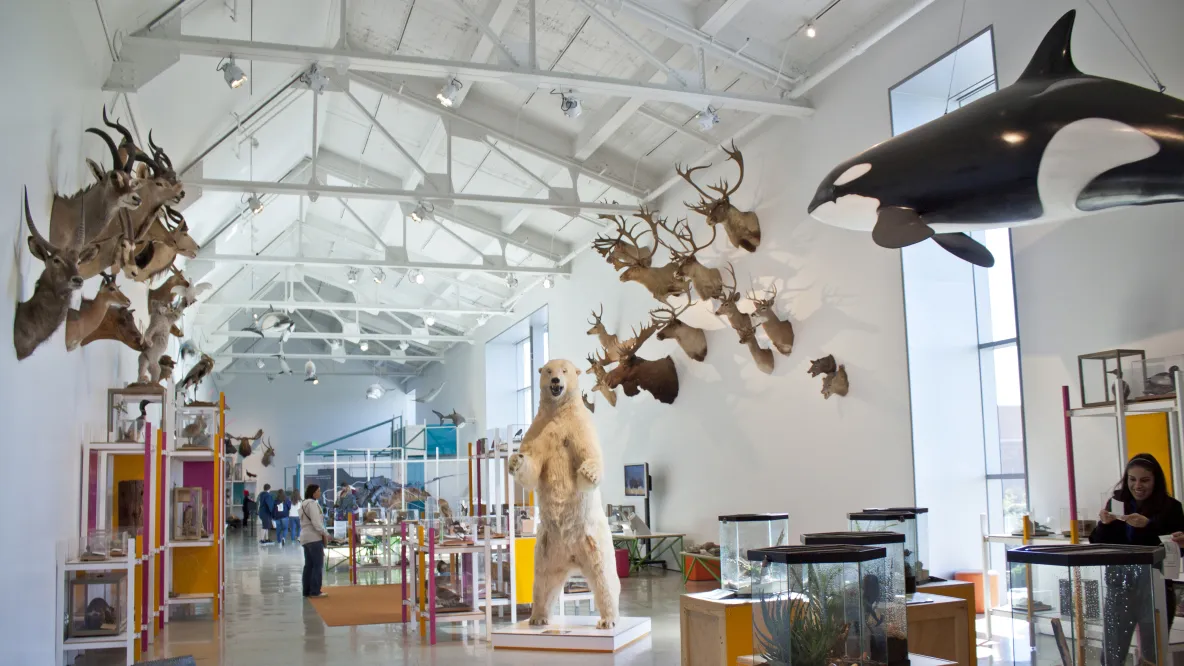
The museum’s collection eventually grew to include more than 238,000 artifacts—one of the largest and most significant collections of Native American materials in the United States. A distinctive spiral staircase in the Caracol Tower and a tunnel entrance with Mayan-themed alcoves gave visitors a dramatic introduction to the collections within.
The Southwest Museum operated independently until 2003, when financial difficulties led to its merger with the Autry Museum of Western Heritage. Much of the collection has since been moved to the Autry’s Griffith Park location or placed in storage, though the historic building on Museum Hill remains a designated Los Angeles Historic-Cultural Monument and continues to host limited public programming.
Architecture on the Slopes
The physical challenges of building on Mount Washington have produced a neighborhood characterized by architectural variety and ingenuity. Houses cling to hillsides at angles that would be impractical on flat terrain, connected by steep driveways and staircases rather than conventional streets.
The neighborhood has attracted notable architects drawn to the creative possibilities of its topography. A. Quincy Jones designed the Pilot House in 1948, a pioneering example of post-and-beam construction adapted to hillside living. The Sea View Lane Residential Historic District features custom homes from the mid-century modern era, many with the expansive glass walls and cantilevered decks that became signatures of California modernism.
The housing stock spans multiple eras and styles. Victorian and Craftsman homes from the neighborhood’s early years mix with mid-century moderns and contemporary constructions. Some properties began as hunting lodges or retreat cottages, modest structures that have been expanded and renovated over generations. Others represent the subdivision tract development of the postwar period, including the 1964-1966 Mount Washington West development, which introduced Ranch-style homes on stilts to navigate the steep slopes.
In 2013, Curbed Los Angeles described the neighborhood as “architecturally blessed,” noting its concentration of historically significant properties. The designation extends to individual homes like the Dr. Fong Q. and Lorraine Jing residence, a mid-century modern home with Early Modern influences that the Los Angeles Cultural Heritage Commission recommended for placement on the Historic-Cultural Monument List. The Jing family built the home in Mount Washington partly because racial covenants and discrimination prevented them from purchasing property in Glendale and Burbank.
The Steepest Streets and the Character of the Hill
Eldred Street, on the northeast side of Mount Washington, has a slope of 33 percent grade—making it one of the three steepest streets in Los Angeles and one of the steepest in the world. Residents of Eldred Street have earned their own unofficial designation: the Eldred Highlanders.
The street draws visitors who want to experience its vertiginous incline for themselves. At the end of the road, the Eldred Steps provide access to a trailhead, making the climb worthwhile for hikers seeking entrance to the neighborhood’s canyon trails. The wooden stairs are among the oldest in Los Angeles, predating the elaborate public staircases that have become a distinctive feature of the city’s hillside neighborhoods.
These geographical quirks have shaped the character of the community. Mount Washington lacks the commercial thoroughfares common in Los Angeles neighborhoods—the terrain simply doesn’t accommodate them. Instead, residents travel down the hill for shopping and dining, often to adjacent areas like Highland Park and Eagle Rock, where Figueroa Street and York Boulevard offer the restaurants, cafés, and galleries that have proliferated as Northeast Los Angeles has gentrified.
The isolation is a selling point for many who choose to live here. Real estate agents describe Mount Washington as offering “the solace of remote, hillside living” while remaining close to the cultural amenities of the surrounding communities. It takes twenty minutes to reach downtown Los Angeles, thirty-five minutes to Santa Monica—but the winding roads and limited access points create a sense of separation that distance alone cannot account for.
The Contemporary Neighborhood and Its Evolving Demographics
Mount Washington has changed substantially over the past two decades. The 2000 census recorded a population of about 12,700 residents, predominantly Latino with significant white and Asian minorities. More recent estimates place the population closer to 17,000, reflecting the broader growth of Northeast Los Angeles as young professionals and families have moved into areas once considered distant from the city’s established centers of affluence.
Home prices have risen accordingly. Starter homes on the hill now begin around $850,000 to $1.2 million for smaller properties—some as modest as 700 square feet, tucked into the crevices of the terrain. Larger homes with views can exceed $1.7 million. Mount Washington Elementary School, consistently ranked among the top public schools in Los Angeles, adds to the area’s appeal for families willing to pay the premium.
The median household income has risen, the racial and ethnic composition has shifted, and the average age of residents has increased—from 33 in 2008 to 38 in more recent surveys. These are the markers of gentrification that have become familiar throughout urban America, and Mount Washington has experienced them alongside its neighboring communities.
Yet certain characteristics persist. The neighborhood remains primarily residential, without the density of retail establishments found elsewhere. Small restaurants and corner markets serve local needs, but Mount Washington has resisted becoming a destination in the way that Highland Park and Silver Lake have. The Self-Realization Fellowship gardens continue to draw visitors seeking quiet contemplation. The views from the hilltop still stretch to the ocean on clear days.
Living with Fire and Slope
The same topography that gives Mount Washington its appeal also exposes it to distinctive risks. The City of Los Angeles designates the neighborhood as a very high fire hazard severity zone—a classification established following the 1991 Oakland Hills Firestorm to identify areas with steep terrain and flammable chaparral vegetation.
Climate-driven factors have intensified these concerns. Prolonged dry periods followed by strong winds create conditions conducive to rapid fire spread, threatening homes and infrastructure along the hillsides. Recent assessments indicate moderate overall wildfire risk for properties in the area over the next 30 years—a timeline that concentrates the attention of homeowners and insurers alike.
Landslide potential presents another concern. The combination of steep slopes and occasional heavy rains can destabilize soil, particularly after periods of drought or fire have stripped vegetation from the hillsides. A 1969 landslide documented through geological soil sampling and a 2000 house collapse on a Mount Washington slope underscore this vulnerability.
These risks are not abstractions for residents. They shape insurance costs, inform building decisions, and require attention to vegetation management and emergency preparedness. Living on the hill means accepting a degree of uncertainty that flat-terrain dwellers never confront.
A Neighborhood That Defies the Los Angeles Norm
Mount Washington exists as a kind of counterexample within Los Angeles—proof that not every neighborhood need surrender to the car, the strip mall, the relentless flattening of space and experience that characterizes so much of the metropolitan region. Its streets remain too narrow and steep for casual traffic. Its commercial offerings remain modest. Its attractions—a spiritual sanctuary, a historic museum, views that encompass mountains and ocean—resist easy commodification.
The neighborhood has changed, and will continue changing. The pressures that have transformed Highland Park and Echo Park and Silver Lake inevitably reach the hilltop. But the topography itself imposes limits. There is only so much developable land on a 940-foot hill with slopes that reach 42 percent grade. The roads will never be widened into boulevards. The stairs will never become escalators.
What remains is a community shaped by its elevation—a place where the effort required to arrive creates a sense of arrival, where the views reward the climb, where a century of history has deposited layers of meaning onto slopes that once held nothing but chaparral. Mount Washington is not the Los Angeles that visitors expect, but it is part of the Los Angeles that actually exists: varied, surprising, occasionally transcendent, always more complicated than its reputation suggests.
For visitors, the Self-Realization Fellowship meditation gardens offer free public access during designated hours. The Southwest Museum building, though currently closed for regular programming, occasionally hosts special events. And Eldred Street remains open to anyone with the fortitude—or the four-wheel drive—to attempt its notorious grade.