

There are beaches up and down the California coast that are prettier, cleaner, and far more serene than Venice Beach. Malibu has its dramatic cliffsides. Santa Barbara has its colonial charm. Laguna Beach has galleries and tidepools and a certain tasteful restraint. Venice Beach has none of that restraint, and that is precisely the point.
Venice Beach is loud, weird, sun-scorched, and unapologetically itself. It is the kind of place that has been declared dead, gentrified, over, and finished roughly every decade since its founding — and every time, it shakes off the obituary and comes back stranger than before. In a state defined by reinvention, Venice Beach is the reinvention capital. It has been a failed resort town, a canal city, a beatnik haunt, a hippie enclave, a gangster territory, a bodybuilder’s kingdom, and now, somewhat improbably, a tech corridor — all while maintaining the same fundamental chaos that has defined its boardwalk since the early twentieth century.
To understand Venice Beach is to understand something essential about Los Angeles itself: that the city has always had a soft spot for the unclassifiable, the outrageous, and the slightly unhinged. Venice Beach is where that soft spot goes to live in the open air, year-round, without apology.
The Fever Dream That Built It All
The story of Venice Beach begins with a man who had too much money, too much ambition, and an absolutely unhinged love of Renaissance Italy. Abbot Kinney was a tobacco millionaire from New Jersey who came to Southern California in the 1890s for his health and ended up reshaping a stretch of boggy Pacific coastline into something no one asked for and everyone eventually came to love.
Kinney’s vision was spectacularly literal: he wanted to build Venice. Not a Venice-inspired development, not a Venice-adjacent community — actual Venice, transplanted to Southern California. He had sixteen miles of canals dug into the marshland south of Santa Monica. He imported gondoliers from Italy. He built colonnaded buildings along the waterfront, hired architects who understood arched loggias, and opened the whole thing to the public in 1905 as “Venice of America.”
The public showed up in enormous numbers and proceeded to completely ignore the high-minded cultural vision Kinney had worked so hard to construct. They wanted carnival rides, not art. They wanted roller coasters, not lectures on Italian Renaissance architecture. They wanted funnel cake and cheap thrills, not gondola serenades. Kinney, to his great credit, shrugged and gave the people what they wanted. He built an auditorium, a miniature railroad, a ship-shaped restaurant, and a ballroom. The canals — the entire architectural centerpiece of his project — were eventually paved over in 1929 to make way for cars.
What survived from Kinney’s original vision was not the canals or the gondoliers or the Venetian architecture. What survived was the spirit of the enterprise: the willingness to be absurd, theatrical, and completely over the top in service of a good time. That spirit has never left. It has simply evolved, generation by generation, into whatever form the moment demands.
The Boardwalk: A Three-Mile Stage Without a Script
The Venice Beach Boardwalk — technically Ocean Front Walk — is one of the most famous pedestrian strips in the world, and it earns that fame through sheer density of spectacle. Three miles of beachside pavement serve as an open-air stage where the performers and the audience are often the same people, and the show runs seven days a week without intermission.
On any given Saturday morning, a walk down the boardwalk will present you with a man playing electric guitar on roller skates, a woman selling hand-painted portraits of people she has never met, a bodybuilder the size of a small SUV flexing under an outdoor gym structure rusted into a kind of muscular permanence, a prophet with a megaphone and a detailed theory about the moon, several smoke shops with names that leave little to the imagination, a circle of drummers who have been playing since Thursday, and at least one dog wearing sunglasses with the calm, unbothered energy of someone who has seen all of this before.
The key to the boardwalk is that none of it is curated. There is no creative director deciding which performers get space and which don’t. The whole thing operates on a kind of democratic chaos that mirrors the city around it. Spots are claimed early in the morning by people who have been showing up for years, sometimes decades. The guy who sells painted rocks has his territory. The man who lifts weights at Muscle Beach understands his position in an informal hierarchy that predates most of the businesses around him. The tarot reader by the public restrooms has been there long enough that she is practically a landmark.
This is not to romanticize poverty or the sometimes desperate circumstances that bring people to perform for tips on a public boardwalk. Many of the people who work the Venice Beach boardwalk are grinding hard just to get through the week, and the economics of being a street performer in a tourist economy are brutal. But the boardwalk, at its best, represents something genuinely rare in contemporary American public life: a truly open commons where people from every background can show up, take up space, and be seen.
Muscle Beach: Where the Body Is the Art
If the boardwalk is Venice Beach’s theater, Muscle Beach is its gallery — a gallery whose exhibits are entirely composed of human bodies pushed to their physical extremes.
The outdoor weightlifting area known as Muscle Beach has been part of Venice’s identity since the 1950s, when bodybuilders began gravitating to the outdoor gym equipment and the year-round sunshine that made training outside not just possible but genuinely pleasurable. Arnold Schwarzenegger trained here during his competitive years. Lou Ferrigno — the original Incredible Hulk — built part of his physique under the open sky at Venice. The golden era of bodybuilding, the 1970s and early 1980s, was documented obsessively at this beach, most notably in the 1977 documentary Pumping Iron, which turned Schwarzenegger into a celebrity and turned Muscle Beach into a pilgrimage destination.
Today, the outdoor gym is still operating, still populated by people who are visibly, spectacularly committed to their physical development. The equipment is simple — pull-up bars, parallel bars, bench press stations, dip bars — but the people using it are anything but. On a weekend afternoon, the area around Muscle Beach becomes a kind of informal performance space where athletes, acrobats, and bodybuilders demonstrate what the human body can do when given years of focused attention and enough protein.
What makes Muscle Beach interesting rather than just impressive is the democratization of the space. Yes, there are people here who are genuinely enormous, whose arms are the size of other people’s legs, who make the laws of proportion seem optional. But there are also regular people doing pull-ups. There are teenagers learning to handstand. There are older men who have been coming here for thirty years and will be here for thirty more. The bar for entry is showing up, and the culture — for all its physical extremity — tends to be welcoming to anyone willing to put in work.
The Canals: Venice’s Forgotten Secret
Walk six blocks east from the boardwalk and you will find something that seems to belong in an entirely different city. The Venice Canals — the surviving remnant of Abbot Kinney’s original vision — are a quiet, impossibly charming neighborhood of small bridges, flower-draped walkways, and modest homes that back directly onto the water.
The canals that remain today are a much-reduced version of what Kinney built, covering only about a dozen blocks in a residential neighborhood that somehow resisted the pressure to pave everything over. In the 1990s, the canals underwent a significant restoration, and today they are genuinely lovely: clear water reflecting the overhanging willows and bougainvillea, ducks moving between the bridges, residents walking small dogs along paths that are open to the public but feel almost secretly intimate.
The contrast between the canal neighborhood and the boardwalk, just a short walk away, is one of the more startling experiences Venice Beach offers. The boardwalk is maximalist, overcrowded, and aggressively stimulating. The canals are the opposite: quiet enough on a weekday morning that you can hear water lapping against the banks, unhurried enough that you might stand on a bridge for ten minutes watching a great blue heron work its way along the waterline without feeling like you are holding anyone up.
The canal neighborhood is also genuinely beautiful in a way that earns the comparison to its Italian inspiration. The homes are small by Los Angeles standards, many of them Arts and Crafts bungalows and mid-century cottages, and the walkways along the water are free of cars, which gives the whole area a pedestrian intimacy that is almost shocking in a city designed almost entirely around the automobile. Real estate here is extraordinarily expensive, which creates its own set of tensions in a neighborhood that spent decades as a working-class enclave, but the physical beauty of the place is undeniable.
The Skate Park: Concrete Poetry
The Venice Beach Skate Park sits at the south end of the boardwalk, and it is one of the best public skate parks in the United States — not because of its size or its equipment budget, but because of what it has become organically over the decades.
The park is built directly on the beach, with a concrete surface that flows between bowls, banks, and ledges with a kind of sculptural elegance. On a busy afternoon, it is a masterclass in spatial negotiation: dozens of skaters of varying ages and abilities sharing the same concrete waves, reading each other’s trajectories with the kind of hyperaware peripheral vision that only comes from years of practice in tight spaces.
Watching skilled skaters work through the Venice bowls is a genuinely aesthetic experience. The way a good skater reads the terrain — finding the line through a bowl, carrying speed from one section into the next, launching off a lip and coming back down in exactly the right spot — is a form of physical intelligence that shares more with dance or music than it does with conventional athletics. There is improvisation involved, and there is also deep structural knowledge: understanding how gravity works in a curved space, how momentum can be stored and released, how to read a surface that is simultaneously obstacle and instrument.
The skate park at Venice has also been a historical staging ground for generations of Southern California skate culture. Many of the stylistic innovations that spread from Southern California skating to the rest of the world were developed and refined in the outdoor parks and empty backyard pools of the Venice area. The culture that grew up around this — the fashion, the music, the art, the attitude — became one of the more globally influential aesthetic movements to emerge from Los Angeles in the late twentieth century.
The Tech Intrusion and the Battle for Venice’s Soul
In the early 2010s, something arrived in Venice Beach that the neighborhood had never quite encountered before: serious money wearing casual clothes. Silicon Beach — the informal name for the tech industry corridor that developed in Venice and neighboring Marina del Rey — brought Google, Snapchat, and dozens of smaller startups to a neighborhood that had always been defined by its relationship with the economically marginal.
The transformation was visible and fast. Buildings that had housed artist studios and small businesses became tech offices with exposed brick and standing desks. Restaurants that had served cheap breakfast burritos for decades were replaced by establishments serving small plates at prices that reflected the new income levels of the neighborhood. Rents, already climbing, accelerated dramatically. The people who had made Venice Beach what it was — the artists, the working-class families, the longtime residents who had stayed through decades of neglect because they couldn’t afford anywhere else — began to be pushed out in significant numbers.
The conflict between old Venice and new Venice has been one of the central dramas of the neighborhood for more than a decade now, and it has not been resolved so much as it has reached an uncomfortable equilibrium. The tech companies mostly adapted their offices to fit the existing aesthetic rather than replacing it entirely — the exposed brick and the vintage signs stayed, even as the income brackets inside changed completely. The boardwalk remained, functionally and legally, a public space that no amount of money could privatize.
What the tech influx did do, perhaps most consequentially, was drive an affordable housing crisis that contributed significantly to the visible homelessness crisis along the boardwalk and throughout the neighborhood. During the COVID-19 pandemic, the encampments along the boardwalk grew dramatically, reaching a scale that prompted eventual city intervention and removal. The tension between the rights of unhoused people to occupy public space and the competing interests of residents and businesses has made Venice Beach a flashpoint in a debate that is being replicated across every major American city.
Street Art and the Walls That Talk Back
Venice Beach has one of the most significant outdoor murals traditions in the United States. The walls along the boardwalk and throughout the neighborhood have served as canvases for artists for decades, and the resulting accumulation of work is staggering in both quantity and quality.
The most famous stretch is Windward Avenue, where layered decades of murals cover virtually every available surface. Some of the work is explicitly political — portraits of activists, commentary on gentrification, tributes to the neighborhood’s Black and Latino communities who shaped so much of its culture while receiving comparatively little of its economic benefit. Some of it is purely aesthetic, exploiting the flat California light to create work of genuine formal sophistication. Some of it is tag culture, the hieroglyphic script of graffiti writers whose work communicates primarily within its own community.
The murals are constantly changing, which means the Venice Beach walls are never the same place twice. A piece that was there last month may have been painted over by something new. This ephemerality is part of the point — the walls are not a museum but a living document, subject to revision and argument and the ongoing negotiation of who gets to define what this place means.
Several artists who got their start on the Venice walls have gone on to significant gallery careers. The connection between street art culture and fine art has never been more visible than it is in Los Angeles, and Venice Beach has been one of the primary sites where that connection developed.
Food, Drink, and the Ritual of the Tacos
A conversation about Venice Beach that does not address the food is a conversation that has missed something essential about how the neighborhood actually functions. For all its counterculture associations, Venice Beach has always had a serious food culture — not in the fine dining sense, but in the sense that feeding people well, cheaply, and with flavor has always been part of the neighborhood’s economy.
The taco stands and trucks in Venice and the surrounding Oakwood neighborhood represent some of the best Mexican food in a city that has some of the best Mexican food in the United States. The al pastor is properly seasoned and properly cooked on a trompo. The carne asada is grilled over real heat. The tortillas are made by hand. These are not tourist tacos; they are the food that the neighborhood eats.
Beyond tacos, the boardwalk food economy is a pageant of American casual eating: corn dogs and funnel cakes and pizza slices and açaí bowls and cold brew coffee and green juice and every kind of thing that can be eaten while walking. The green juice, in particular, has become a Venice cliché — there are enough juice bars within a few blocks of the boardwalk to hydrate a small nation — but the cliché exists because the reality preceded it. Venice Beach was a center of health food culture before health food was cool, partly because the year-round outdoor lifestyle encouraged a certain kind of attention to the body that the rest of the country caught up to decades later.
Sunset and the Quiet Claim
Here is the thing about Venice Beach that the postcards get right even when they get everything else wrong: the sunsets are extraordinary.
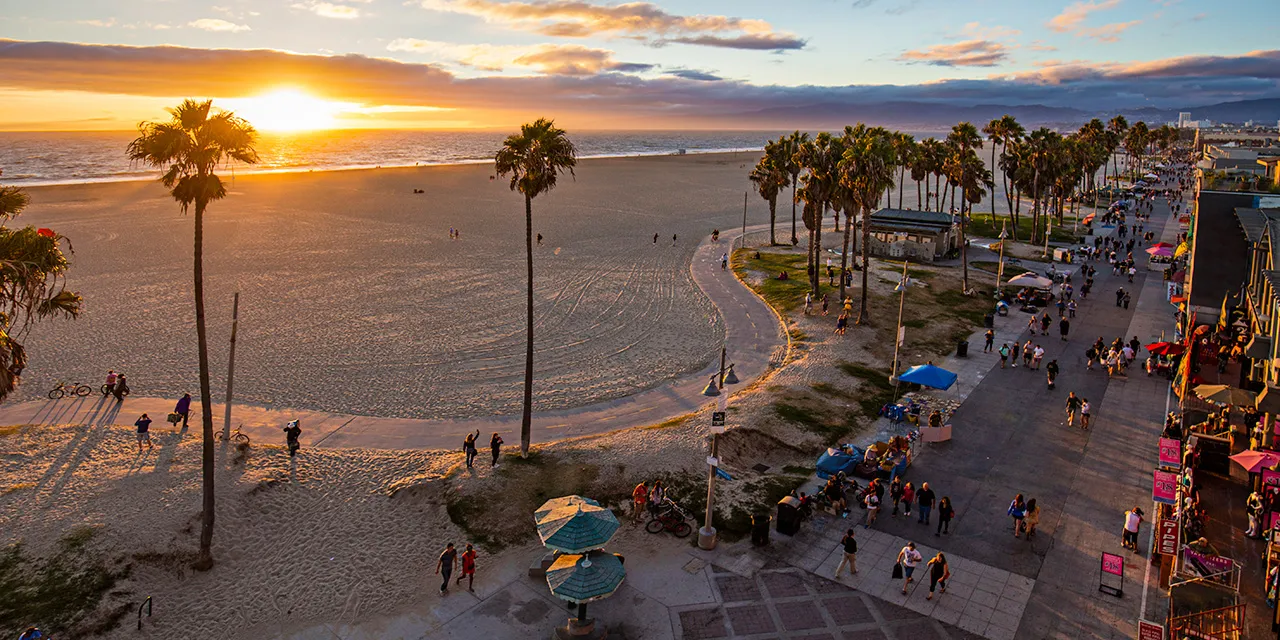
The Pacific faces west here, which means that on a clear evening — and there are many clear evenings — the sky turns colors that seem like an editorial overcorrection, too saturated to be real, orange and pink and deep red layering over the water in a way that stops people mid-sentence. The silhouettes of the palm trees along the boardwalk, the figures of skaters and joggers and cyclists caught in the last light, the long shadows of the lifeguard towers reaching across the sand — all of it comes together in these twenty minutes between late afternoon and dark into something that justifies, quietly, all the noise and chaos and contradiction that the daylight hours deliver.
People gather at Venice Beach in the evenings not because there is an event scheduled but because the event schedules itself, every single day, without fail. The crowd that collects along the waterline at sunset is as demographically varied as the one that arrives for the midday circus — tourists and locals and tech workers and artists and homeless residents and bodybuilders and kids on bikes — and for those twenty minutes, everyone is watching the same thing, experiencing the same light, occupying the same moment.
It is the closest Venice Beach comes to peace, and it is enough.
Why Venice Beach Will Survive Whatever Comes Next
Venice Beach has outlasted every prediction of its death. It survived the failure of Kinney’s original vision. It survived annexation by Los Angeles in 1925. It survived the paving of its canals. It survived the crack epidemic, the gang violence of the 1980s and 1990s, the Silicon Beach invasion, the gentrification wave, the pandemic, and the ongoing crises of housing and homelessness that continue to define its daily reality.
What makes Venice Beach durable is not its physical infrastructure, which is often in bad repair, or its institutional support, which has always been inconsistent, but its culture — a culture built around the idea that public space belongs to everyone and that the people who show up first and loudest and most consistently get to define what it means. That culture is contentious and messy and frequently uncomfortable. It produces conflict as often as it produces community. But it also produces something you cannot find in the curated, sanitized, ticketed public spaces that have become the dominant model for urban entertainment in the twenty-first century: genuine human unpredictability.
Venice Beach is not a theme park. It is not a brand. It is not a lifestyle concept or a content strategy. It is a place where real people, with real needs and real eccentricities and real talent, show up every day and make something out of nothing on a public beach in Southern California. That has been true for over a hundred years. There is no particular reason to think it will stop being true anytime soon.
The circus has no closing time. The boardwalk does not get struck and packed away. The show, such as it is, simply continues — ragged and radiant and stubbornly, defiantly alive.