

Los Angeles is a city of extremes. Billion-dollar film studios sit miles from food deserts. Pristine beaches border neighborhoods without grocery stores. And somewhere in between all of that contradiction, hundreds of thousands of animals pass through a shelter system that is simultaneously one of the most progressive in the nation and one of the most overwhelmed.
This is not a feel-good story about puppies finding forever homes — though there is plenty of that. This is an honest look at what it takes to run animal shelters in a city of four million people, what the numbers actually mean, and why the work being done inside these facilities matters far beyond the animals themselves.
Los Angeles Animal Services — The Backbone of the System
The Los Angeles Department of Animal Services (LAAS) operates six municipal shelters across the city. These are not private rescue organizations. They are government-funded facilities legally obligated to accept every animal brought through their doors — strays, surrenders, cruelty cases, wildlife conflicts, and everything in between.
The Six Shelters and Where to Find Them
- East Valley Animal Care Center – 14409 Vanowen St, Van Nuys, CA 91405
- West Valley Animal Care Center – 20655 Plummer St, Chatsworth, CA 91311
- South Los Angeles Animal Care Center – 1850 W 60th St, Los Angeles, CA 90047
- West Los Angeles Animal Care Center – 11361 W Pico Blvd, Los Angeles, CA 90064
- North Central Animal Care Center – 3201 Lacy St, Los Angeles, CA 90031
- Harbor Animal Care Center – 957 N Gaffey St, San Pedro, CA 90731
Each facility serves a distinct geographic zone, and no, you cannot simply walk into any of them and demand your stray cat be handled by a specific location. Jurisdictional intake is real, it matters, and understanding it can save you hours of confusion.
What Actually Happens Inside a Municipal Shelter
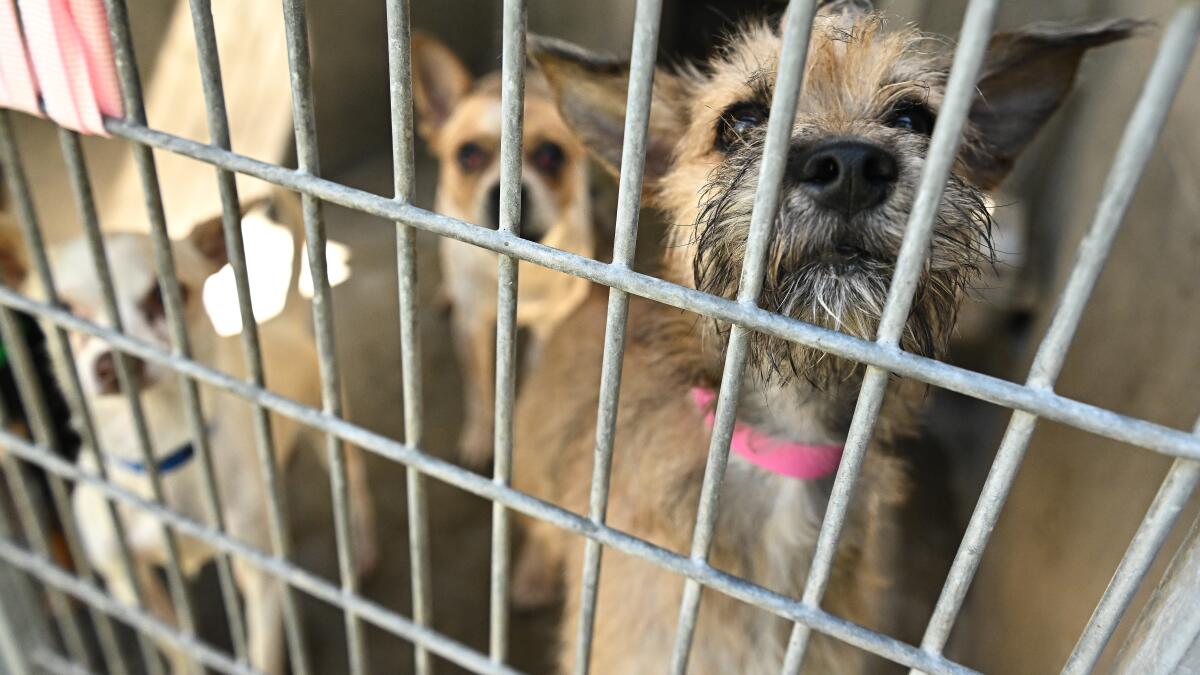
Most people who have never volunteered at or visited an animal shelter carry a cinematic version of what it looks like — rows of sad eyes, dimly lit kennels, overwhelmed staff in scrubs. The reality is both better and more complicated than that.
Animals that arrive at LAAS facilities are scanned for microchips, photographed, assessed for health and temperament, and entered into a publicly searchable database within 24 hours. The system, called Chameleon, feeds into PetPoint, which in turn syncs with Petfinder and Adopt-a-Pet so that animals become searchable almost immediately after intake.
Stray animals are held for a legally mandated period — typically 72 hours to five days depending on species and circumstances — to allow owners time to reclaim them. Only after that hold period expires do animals become available for adoption, rescue transfer, or, in cases where behavioral or medical conditions make other outcomes impossible, euthanasia.
The word “euthanasia” deserves honest treatment here. For decades, Los Angeles shelters euthanized animals not because those animals were sick or dangerous, but simply because there were too many and not enough space. That era has not entirely ended, but the numbers have improved dramatically. In 2012, LAAS euthanized more than 20,000 animals. In recent fiscal years, that number has fallen below 5,000, a reduction driven by aggressive spay/neuter programs, community cat initiatives, and a rescue partner network that now includes hundreds of nonprofit organizations.
The Private Rescue Ecosystem — Where the Real Innovation Lives
The municipal shelters are the floor, not the ceiling. The innovation in Los Angeles animal welfare happens in the private rescue sector — a sprawling, scrappy network of nonprofits, fosters, and breed-specific organizations that pull animals from public shelters and place them in homes.
Best Friends Animal Society — Los Angeles Campus
3367 Wilshire Blvd, Suite 250, Los Angeles, CA 90010
Best Friends Animal Society runs the largest no-kill animal sanctuary in the United States out of Utah, but their Los Angeles operation is a major force in local animal welfare. Their L.A. team runs a dog adoption center, a cat adoption center, and a robust foster program. They work closely with LAAS to pull high-risk animals — those most likely to face euthanasia — and place them in foster homes across the region.
Their annual Super Adoption events, held multiple times a year in partnership with dozens of other rescue organizations, bring together thousands of animals and adopters in a single weekend. These events have resulted in tens of thousands of successful adoptions over the years.
Lange Foundation
5250 W Century Blvd, Los Angeles, CA 90045
The Lange Foundation is a no-kill nonprofit founded in 1993, making it one of the oldest continuously operating animal rescue organizations in Los Angeles. They focus primarily on dogs and cats, running a small but well-organized adoption center near LAX and a foster network that stretches across the San Fernando Valley and beyond.
What sets Lange apart is their commitment to animals with medical needs. They have taken in dogs recovering from heartworm treatment, cats with chronic conditions, and animals that other rescues passed over because the vet bills were too steep.
Stray Cat Alliance
P.O. Box 861561, Los Angeles, CA 90086 (operations throughout the city)
For cats specifically, the Stray Cat Alliance has become one of the most effective organizations in the country. Their model centers on Trap-Neuter-Return, known as TNR, the practice of humanely trapping feral and community cats, having them spayed or neutered, vaccinating them, and returning them to their outdoor territory.
TNR is controversial in some circles — bird conservationists argue that outdoor cats devastate wildlife populations, and they are not wrong. But for managing the sheer volume of feral cats in an urban environment, it is currently the most practical tool available. Los Angeles has an estimated 1.5 to 3 million community cats depending on whose estimate you trust, and surgical sterilization remains the only proven method of reducing that population over time.
The Overcrowding Problem Nobody Wants to Talk About
Here is the part of the story that gets sanitized in feel-good shelter profiles: overcrowding in Los Angeles animal shelters is a chronic, structural problem, and it does not have a simple solution.
When shelters are at or above capacity — which happens routinely in spring and summer, the peak of kitten season — animals are doubled up in kennels, wait times for intake become longer, staff are stretched thin, and the risk of disease transmission inside the shelter goes up. Kennel cough, ringworm, and upper respiratory infections spread through shelter populations quickly when density is high. Animals that arrived healthy can leave sick, and sick animals are harder to adopt and more expensive to treat.
The root causes are well understood: insufficient spay/neuter access in low-income communities, the abandonment of animals after moving or financial hardship, the collapse of informal rehoming networks during economic downturns, and a consistent gap between the number of people who want a pet and the number willing to adopt from a shelter rather than buy from a breeder.
Los Angeles County has invested in low-cost spay/neuter clinics, mobile surgical units, and community outreach programs, but the scale of the need consistently outpaces the resources deployed to meet it.
SPCALA and Pasadena Humane — The Adjacent Networks
Los Angeles city shelters are not the only game in town. The county contains dozens of incorporated cities that contract their animal services independently, and several major private humane organizations operate their own shelters.
SPCALA (Society for the Prevention of Cruelty to Animals Los Angeles)
Agoura Animal Care Center 29525 Agoura Rd, Agoura Hills, CA 91301
Hawthorne Animal Care Center 4951 W El Segundo Blvd, Hawthorne, CA 90250
SPCALA is one of the largest humane societies on the West Coast. It holds law enforcement contracts with several municipalities, meaning their officers respond to cruelty complaints and stray animal calls just like LAAS does in the city. Their adoption programs are well-regarded, and their community outreach — including a free spay/neuter program for residents who qualify — has a measurable impact.
Pasadena Humane
361 S Raymond Ave, Pasadena, CA 91105
Pasadena Humane serves Pasadena and several neighboring cities under contract, including Arcadia, Monrovia, and Sierra Madre. What makes Pasadena Humane worth noting is their investment in facility quality. Their campus is modern, relatively spacious, and organized in a way that reduces stress for the animals housed there. Kennels have outdoor runs. Cat rooms are designed to allow communal socialization. The difference in how animals present — and therefore how adoptable they appear to potential adopters — is real.
Foster Care — The Quiet Revolution
The single most important development in animal shelter medicine over the past decade has not been a drug, a surgery, or a funding windfall. It has been foster care.
The premise is simple: animals do not thrive in shelters. The noise, the unfamiliar smells, the lack of personal attention, the disruption of normal sleep patterns — all of it produces stress responses that make animals seem more anxious, reactive, and difficult than they actually are at baseline. An anxious dog in a shelter kennel may bark, pace, and lunge at the gate. That same dog in a quiet foster home may be gentle, calm, and thoroughly adoptable.
Los Angeles shelter systems have invested heavily in building foster networks, and private rescues have made fostering their primary operational model. Best Friends LA alone has maintained a foster base of over 1,000 volunteers in active years. LAAS runs its own foster program, with animals placed in homes during medical recovery, behavioral rehabilitation, or simply while waiting for adoption.
For anyone wanting to help but not ready to adopt, fostering is the highest-leverage contribution available. You are not just providing temporary housing. You are generating behavioral data that helps the organization match the animal to the right permanent home. You are relieving shelter capacity, which has downstream effects on every animal in the system. And you are, in many cases, saving a specific life.
What Volunteers Actually Do — And Why It Matters
Volunteerism at Los Angeles animal shelters is not optional nicety. It is load-bearing infrastructure.
LAAS volunteers walk dogs, socialize cats, assist with adoption events, staff meet-and-greet sessions, photograph animals for online listings, and provide behavioral enrichment. Without that volunteer labor, the operations of every facility would be measurably worse. Animals would receive less human contact. Behavioral deterioration in long-term residents would accelerate. Adoption rates would fall.
The volunteer pipeline also functions as a talent pipeline. Many of the staff at private rescue organizations started as LAAS volunteers. Several founders of active Los Angeles rescue nonprofits spent years volunteering at municipal shelters before building their own organizations.
If you live in Los Angeles and are considering volunteering, the process varies by facility but generally involves an online application, an orientation session, and a criminal background check for anyone working with animals directly. Some facilities require a training shift before solo volunteering is permitted. It is worth the friction.
The Intersection of Animal Welfare and Community Development
Animal shelters do not exist in a vacuum. In Los Angeles, as in most American cities, the neighborhoods that send the most animals to shelters are the same neighborhoods with the least access to veterinary care, the least stable housing, and the most financial precarity.
When someone surrenders a dog to South Los Angeles Animal Care Center because they are being evicted and the new apartment does not allow pets, that is not primarily an animal welfare problem. It is a housing problem that has spilled into the shelter system. When an elderly woman in the San Fernando Valley can no longer care for her cats because she is hospitalized and has no family nearby, that is a healthcare and social isolation problem.
The most forward-thinking shelters in Los Angeles have started grappling with this honestly. Programs that provide temporary boarding for animals while their owners navigate housing crises, that offer emergency veterinary assistance to prevent surrenders, and that partner with social service agencies to address the underlying conditions that produce shelter intake — these are the frontier.
It is slower and more expensive than adoption events and social media campaigns. But it is also more durable.
How to Adopt, Foster, or Help Right Now
Adopting from LAAS
All six city shelters list animals at laanimalservices.com. Adoption fees include spay/neuter, vaccinations, and microchip. LAAS periodically runs fee-waived adoption promotions during periods of high intake.
Emergency Foster Needs
When shelters are at capacity, emergency foster requests go out through social media — primarily Instagram and Facebook. Follow LAAS and major rescue organizations for those alerts. Emergency fosters are often needed within 24 to 48 hours and are given supplies and support.
Financial Support
Donating to the LAAS Foundation funds programs that do not fit into the municipal budget — behavioral enrichment, transport equipment, emergency medical care. Donations to private rescues like Best Friends, Lange Foundation, and Stray Cat Alliance go toward operational costs.
Lost and Found Animals
If you have found a stray animal, the fastest path to reconnecting it with its owner is scanning for a microchip at any LAAS facility, any veterinary office, or many pet supply retailers. Posting to the Nextdoor Neighbors app, local Facebook lost-and-found groups, and the Pawboost platform increases the likelihood of a match.
The Road Ahead — Where Los Angeles Animal Welfare Is Going
Los Angeles has made genuine progress. Euthanasia numbers are down significantly from their peak. Live release rates have improved. The rescue partner network has grown. Foster infrastructure is stronger than it has ever been.
But no-kill is not a destination you reach and then stop working. The city’s population keeps growing. Economic cycles keep producing housing instability and financial hardship. And every spring, the kittens keep coming.
The next phase of progress in Los Angeles animal welfare will likely come from three directions: better data sharing across the fragmented shelter ecosystem, deeper integration with social services to address intake at its roots, and continued expansion of community-based programs that treat pet ownership in low-income neighborhoods as something worth preserving rather than something to be managed at intake.
The animals in those kennels in Van Nuys and San Pedro and Chatsworth are not just waiting for individual people to fall in love with them. They are waiting for systems to get good enough that they never end up there in the first place.
Until then, the doors stay open. The staff and volunteers show up. And the work continues.
For current adoptable animals, volunteer information, and donation opportunities, visit the Los Angeles Department of Animal Services at laanimalservices.com. For rescue partnership inquiries, contact Best Friends Animal Society’s Los Angeles team at bestfriends.org/adopt/los-angeles or the Lange Foundation at langefoundation.org.