

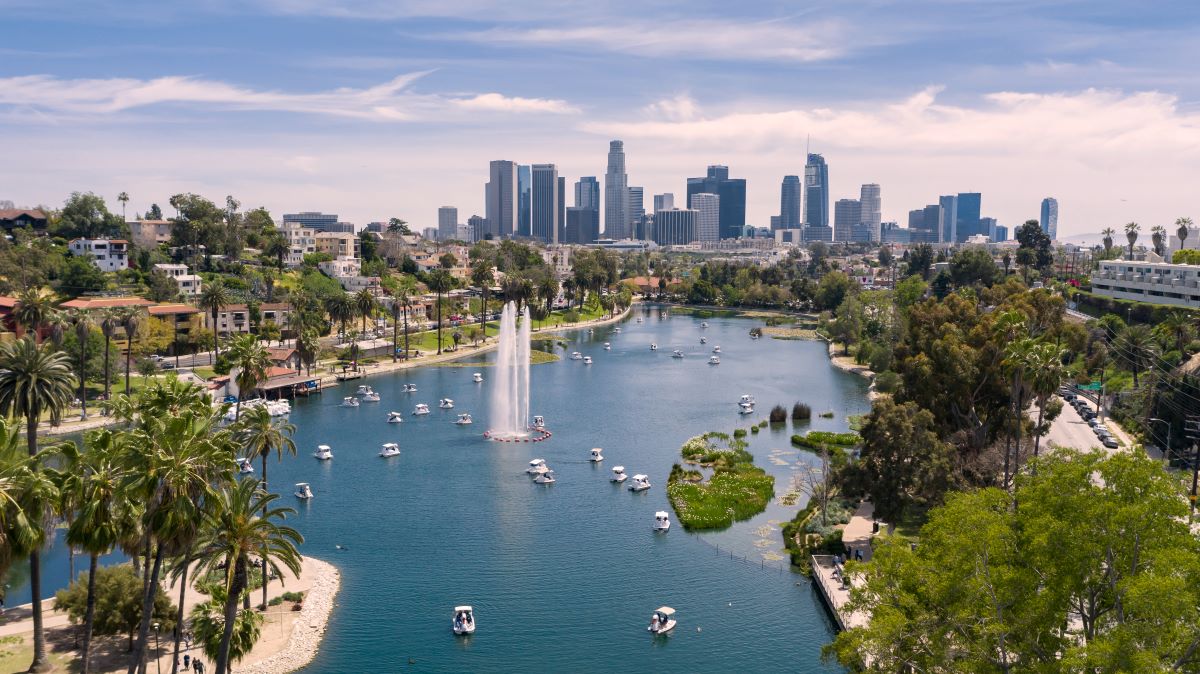
There is something about water in a desert city that makes it precious, almost sacred. In Los Angeles, a sprawling metropolis that has spent more than a century wrestling with drought and aquifer depletion, the bodies of water that remain have taken on significance far beyond their practical utility. None embodies this truth quite like Echo Park Lake, a 29-acre stretch of tranquil water nestled just northwest of Downtown, where the glittering skyline serves as an ever-present backdrop to paddle boats, blooming lotus flowers, and over 150 years of California history.
What began as a utilitarian drinking water reservoir in the late 1860s has transformed into one of the most beloved urban parks in Southern California. The lake has witnessed the birth of American cinema, the rise of megachurch evangelism, the creative renaissance of a once-neglected neighborhood, and the painful realities of the homelessness crisis that continues to grip the nation. Its waters have reflected both the glamour and the grit of Los Angeles, making it something more than a park—it is a living document of the city’s contradictions and triumphs.
From Reservoir Number 4 to Urban Oasis
The story of Echo Park Lake begins not with recreation, but with survival. In 1868, the Los Angeles Canal and Reservoir Company completed construction of what was then prosaically named Reservoir Number 4. The project was straightforward: workers dammed a natural arroyo called Arroyo de Los Reyes and dug a serpentine canal that diverted water from the Los Angeles River in what is now the Los Feliz neighborhood. The water flowed along this zigzag path until it emptied into the newly formed reservoir.
Once filled, Reservoir Number 4 became the largest body of water within the Los Angeles city limits. The intention was to power a woolen mill located on 6th and Figueroa Streets and to provide drinking water to a rapidly growing city. But the commercial venture failed to generate the returns its investors had hoped for. By the late 1880s, the reservoir had become more of a liability than an asset.
Enter Thomas Kelley, a carriage maker with an eye for real estate. Kelley and five other speculators purchased the property surrounding the reservoir and subdivided it into what they called the Montana Tract. Lots were advertised in the Los Angeles Times in 1887, and the developers began to see the water not as a commercial resource but as an amenity that could attract wealthy residents to this part of town—then considered the city’s “West End.”
The transformation from reservoir to park came in 1891, when the Los Angeles Canal and Reservoir Company donated the 33-acre site to the city for use as a public recreation space. A year later, work began to convert the utilitarian water storage facility into an English-style park. Joseph Henry Tomlinson, the city’s first Superintendent of Parks and a landscape architect who had emigrated from Derbyshire, England, oversaw the project. According to legend, Tomlinson chose the name “Echo Park” after hearing his voice reverberate across the arroyo during construction.
Tomlinson modeled his design after Shipley Park in his hometown, creating what he called a “picturesque style” landscape with open lawns, groves of trees, and winding pathways that traced the water’s edge. Workers reinforced the dam with clay, excavated thousands of cubic yards of dirt to create an island at the lake’s center, and lined the shores with riprap quarried from nearby Elysian Park. By 1895, Echo Park had officially opened to the public.
The Silver Screen’s First Stage
What few visitors realize today is that Echo Park holds a legitimate claim to being the birthplace of American cinema. Before Hollywood became synonymous with moviemaking, a section of Echo Park known as Edendale served as the West Coast’s filmmaking hub.
By the 1910s, several film studios had set up operations along Allesandro Street, which would later be renamed Glendale Boulevard. The Selig Polyscope Company, Pathe West Coast Film Studio, and most famously, Mack Sennett’s Keystone Studios all called this neighborhood home. The original Keystone Studios building, constructed in 1912 at 1712 Glendale Boulevard, still stands today—though it now operates as a public storage facility, an ironic fate for what was once the first totally enclosed film stage and studio in history.
It was at Keystone that the language of screen comedy was essentially invented. Mack Sennett, the Canadian-American producer known as the “King of Comedy,” pioneered the slapstick style that would define American film humor for decades. His Keystone Cops series featured bumbling policemen in elaborate chase sequences that frequently spilled into Echo Park Lake itself. The Bathing Beauties, featuring future stars like Gloria Swanson and Carole Lombard, also emerged from these productions.
The lake became such a popular filming location that city officials eventually banned Keystone Studios from shooting there, citing complaints about trampled flower beds during the chaotic chase scenes. But not before Echo Park Lake had appeared in dozens of silent films, including several early Charlie Chaplin comedies from 1914. “Twenty Minutes of Love” and “Recreation” both feature scenes shot at the lake’s northeast corner, where the young Chaplin was still developing the character that would make him an international icon.
The legacy of this period extends beyond the borders of Los Angeles. When Disney’s Hollywood Studios theme park in Florida was designed, its Echo Lake area was modeled directly after Echo Park Lake—a tribute to the neighborhood’s foundational role in American film history.
Sister Aimee and the Temple Across the Street
Walk to the northeast corner of Echo Park Lake today, and you cannot miss the massive domed structure that dominates the landscape. This is Angelus Temple, the headquarters of the Foursquare Church and one of the most significant religious buildings in American history. Its presence tells another crucial chapter in the Echo Park story.
Aimee Semple McPherson arrived in Los Angeles in 1918, a single mother with a vision that defied the conventions of her era. Women were not yet permitted to vote, but McPherson was already one of the most famous religious figures in the country. She had traversed the United States by automobile, preaching revival meetings and attracting followers by the thousands with her charismatic style and claims of miraculous healings.
When she found the empty lot across from Echo Park Lake, McPherson saw her destiny. She would later describe the park as “heaven on earth,” with its beautiful trees and swans swimming gracefully on the water. By December 1919, she had purchased the land. Three years later, on January 1, 1923, Angelus Temple opened its doors—a 5,300-seat auditorium built entirely with cash donations, debt-free.
The temple was revolutionary in design. Its megaphone-shaped auditorium was optimized for radio broadcasting, and in 1924, KFSG became one of the first religious radio stations in America. McPherson understood the power of media before most of her contemporaries, and she used it to build what many historians consider the first American megachurch.
During the Great Depression, McPherson’s operation fed and clothed more than 1.5 million people through a commissary established in 1927. Her ministry drew so many followers to the Echo Park neighborhood that the local population exploded during the 1920s and 1930s. One persistent local legend credits McPherson with introducing the lotus flowers that still bloom in Echo Park Lake each summer, allegedly bringing the seeds back from a trip to China—though historians debate this claim.
McPherson’s life was as controversial as it was influential. Her mysterious disappearance in 1926, followed by an implausible kidnapping story, made international headlines. She died in 1944 from an accidental barbiturate overdose, estranged from her family but still beloved by her congregation. Today, Angelus Temple continues to operate as an active house of worship, and visitors can tour the adjacent parsonage where McPherson once lived, her bedroom window deliberately positioned to overlook the fountain in Echo Park Lake.
The Lady of the Lake and Depression-Era Art
Standing on a concrete peninsula that juts into the north end of Echo Park Lake is a 14-foot Art Deco statue that has become one of the neighborhood’s most beloved landmarks. Her official name is “Nuestra Reina de Los Angeles”—Queen of the Angels—but locals have always called her simply the Lady of the Lake.
The statue was created in 1934 by California-born sculptor Ada May Sharpless under a commission from the Public Works of Art Project, one of the federal programs designed to employ artists during the Great Depression. Originally intended to be cast in bronze, budget constraints led to the statue being poured in concrete—a material often called “liquid stone” that became a Depression-era favorite.
The Lady of the Lake stands with arms raised, palms outward, facing away from the water. Her pedestal features four bas reliefs depicting iconic Los Angeles landmarks: the Hollywood Bowl, the harbor, the San Gabriel Mountains, and the Central Library. When the statue was unveiled in 1935, Los Angeles Times art critic Arthur Millier expressed disappointment with the work. Sharpless reportedly took the criticism poorly, and Millier never wrote favorably about her work again.
The statue’s history since then has been turbulent. By the mid-1980s, vandals had damaged the Lady badly enough that city workers removed her to a storage yard, where she remained for approximately 15 years. A cinder block pump house was built in her original location. When the statue was finally restored in the late 1990s, she was reinstalled on the lake’s east side near the boathouse. Only during the major 2011-2013 renovation was she returned to her original peninsula location—still facing away from the water, as she always had.
The boathouse that still stands on the lake’s east side dates from 1932, funded by unemployment relief bonds during the Depression. Like the Lady of the Lake, it represents the New Deal ethos that public works could provide both employment and lasting community benefit during times of crisis.
Lotus Flowers and Cultural Celebration
Each summer, Echo Park Lake transforms into something approaching magical. The lotus beds that line portions of the lake burst into bloom, their pink and white flowers rising above broad green leaves to create a spectacle unlike anything else in Los Angeles.
The origins of these flowers remain somewhat mysterious. Most accounts place their introduction sometime around 1923 or 1924. Some historians believe Chinese missionaries from the nearby Angelus Temple planted them for food. Others credit Aimee Semple McPherson herself, claiming she brought lotus seeds back from China. Regardless of their origin, the flowers quickly established themselves and became integral to the lake’s identity.
The lotus beds are now the largest in the United States. Their annual blooming, typically between April and August, draws photographers, nature lovers, and tourists from across the region. The flowers carry deep cultural significance in Asian traditions, symbolizing rebirth, purity, and spiritual enlightenment.
In 1972, the City of Los Angeles Department of Recreation and Parks established what was initially called “Day of the Lotus,” a one-day event to promote awareness of Asian American contributions to the community. The celebration grew over the years, eventually becoming the annual Lotus Festival that now attracts over 125,000 visitors during its July weekend. The festival features dragon boat races, live music, dance performances, and cultural exhibitions highlighting different Asian and Pacific Islander communities each year.
The lotus flowers nearly disappeared in the mid-2000s as lake conditions deteriorated. By 2008, they were practically nonexistent. But during the 2011-2013 renovation, new lotus beds were planted using plants cultivated by horticulturalist Randy McDonald—who had originally obtained them by stealing a cutting from the lake in 2005, a violation of municipal code that eventually earned him $30,000 when the city purchased 376 plants he had grown.
Renovation, Crisis, and Rebirth
By the early 2000s, Echo Park Lake had become a victim of urban neglect. The boathouse had lost its Spanish-style character. The Lady of the Lake sat in a storage yard. Water quality had deteriorated to the point that California designated the lake an impaired body of water in 2006.
That same year, the Echo Park Historical Society successfully nominated the park grounds and lake for designation as City of Los Angeles Cultural Monument Number 836. This recognition sparked renewed interest in the site’s preservation and eventual restoration.
In 2010, the city allocated $64.7 million for a comprehensive cleanup and revitalization project. The lake was drained in 2011, beginning a two-year renovation that would tackle Echo Park Lake not merely as a recreational amenity but as an important component of the Los Angeles ecosystem.
Workers dredged the lake bottom, removing decades of accumulated sediment. A new wetlands feature was added to improve water filtration naturally. A boardwalk and new walking paths were constructed. The lotus beds were replanted. The Lady of the Lake was restored and returned to her original location. When the park reopened on June 5, 2013, it represented one of Los Angeles’s great public works success stories of the new century.
But the story did not end there. Beginning in 2019, a homeless encampment began developing along the lake’s shores. By early 2021, nearly 200 tents had been set up around the park, and Echo Park Lake had become what many described as a “flashpoint in L.A.’s homelessness crisis.”
On March 25, 2021, the park was closed and cleared. The operation sparked significant controversy, with over 200 protesters confronting LAPD officers. The cleanup effort ultimately yielded 35 tons of trash, including 700 pounds of biological waste and 30 pounds of drug paraphernalia. According to city officials, 183 people experiencing homelessness at Echo Park Lake were successfully moved into transitional housing.
The park reopened on May 26, 2021. The city had spent $1.1 million on repairs and cleanup. New hours were established, closing the park between 10 p.m. and 5 a.m. nightly. The episode highlighted the painful tensions between public space, community need, and the failures of housing policy that continue to challenge cities across America.
Echo Park Lake Today
Walk around Echo Park Lake on any given afternoon, and you will encounter Los Angeles at its most democratic. Young families push strollers along the paved path that circles the water. Couples glide across the surface in swan-shaped pedal boats. Yoga groups gather on the grass. Dog walkers navigate around the many geese that have made the park their home.
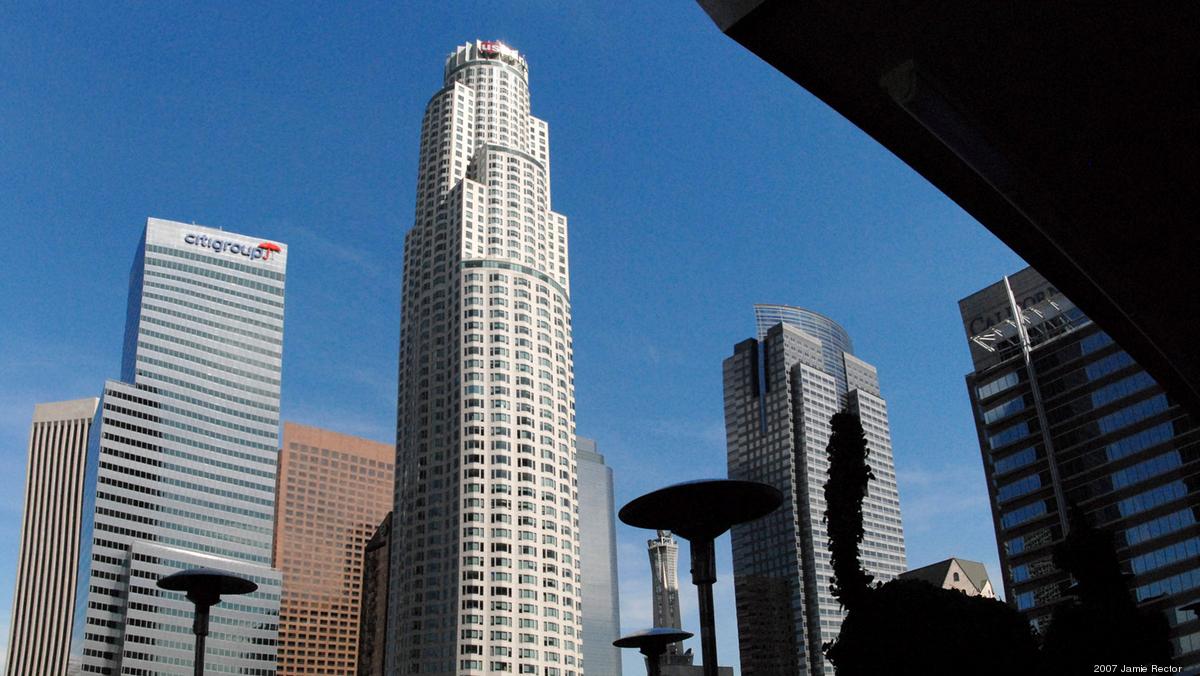
The downtown skyline rises in the distance, a constantly shifting composition of glass and steel that provides the perfect backdrop for the palm trees, fountains, and lotus blooms in the foreground. It is one of the most photographed views in the city, appearing in countless Instagram posts, music videos, and film productions.
The revived boathouse now houses Piknik, a restaurant serving Scandinavian-inspired fare. Swan boats can be rented for approximately $13 per hour. The walking path around the lake measures just under a mile, making it perfect for a leisurely stroll that can include stops at historical markers explaining the park’s layered history.
The Lady of the Lake still stands on her peninsula, facing north, her back to the water. Angelus Temple still fills for weekly services in multiple languages. The original Keystone Studios building still stands a few blocks north on Glendale Boulevard, its history hidden behind a modern retail facade.
Echo Park Lake endures because it represents something essential about Los Angeles—a city that has always been about reinvention, about finding beauty in unlikely places, about communities forming around shared public spaces despite vast differences in background and circumstance. The lake has been a reservoir, a film set, a spiritual center, a symbol of neglect, and a model of urban renewal. It has reflected both the ambitions and the failures of the city that surrounds it.
Today, when the fountain shoots its plume into the Southern California sky and the lotus flowers catch the afternoon light, Echo Park Lake feels timeless. But nothing here is static. The water continues to serve the city’s storm drain system. The park continues to evolve. The neighborhood continues to change. And somewhere, perhaps, an echo still carries across the arroyo where Joseph Tomlinson first imagined what this place could become—a piece of heaven on earth, nestled in the heart of a city still writing its story.