

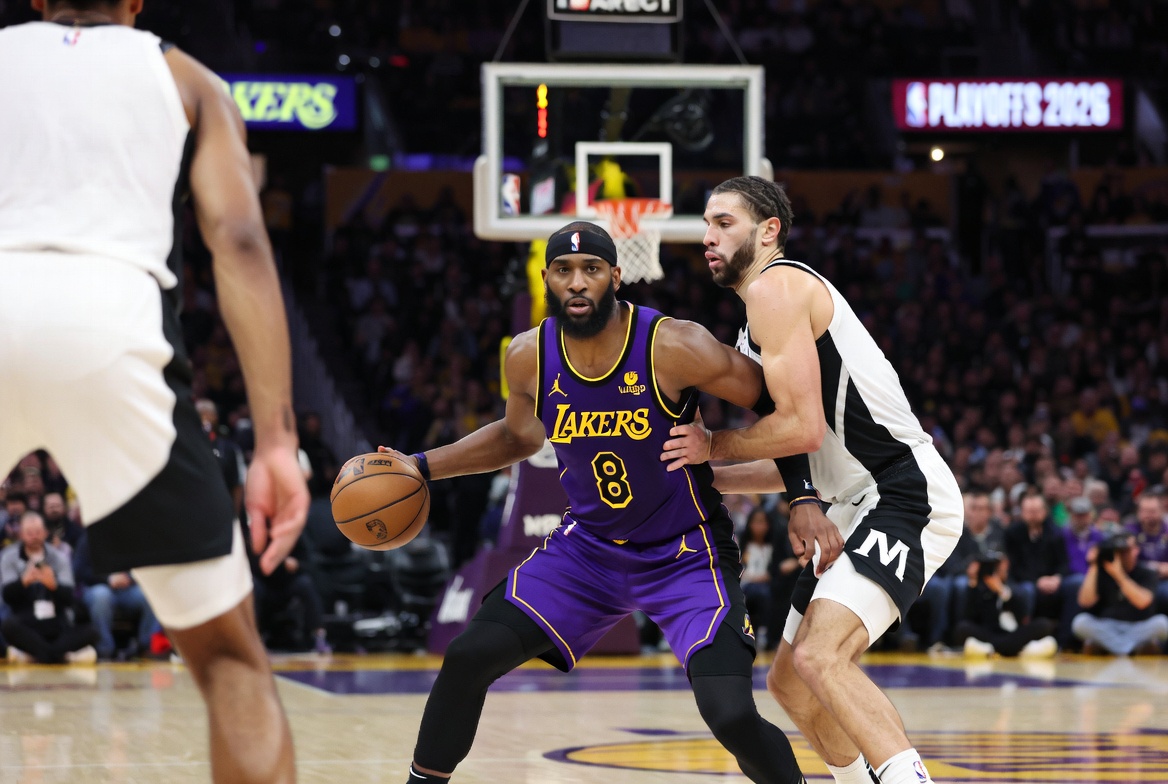
The purple and gold are back where they belong. After years of inconsistency, trade rumors, and the exhausting public theater that comes with being the most scrutinized franchise in professional basketball, the Los Angeles Lakers have quietly — then suddenly, loudly — turned the 2025-26 NBA season into something that matters. With a 53-29 regular season record and a firm grip on a top-three Western Conference seed, the Lakers are heading into the 2026 playoffs as genuine contenders. Not just hopeful contenders. Not “well, anything can happen in the playoffs” contenders. The real kind.
This is what a focused Lakers team looks like. And after the regular season they just put together, the Western Conference should be paying close attention.
The Western Conference Standings: Where the Lakers Fit
Before talking about what the Lakers can do in the playoffs, it’s worth staring hard at the Western Conference standings, because the picture they paint is both encouraging and sobering in equal measure.
The Oklahoma City Thunder finished the regular season at 64-18. That number isn’t a typo. OKC have been the best team in basketball this year — dominant on defense, terrifying in transition, and infuriatingly young. The San Antonio Spurs finished 62-20, continuing the most quietly impressive rebuild in modern NBA history. The Denver Nuggets, perennial Western Conference villains, closed at 54-28.
Then come the Lakers at 53-29, sitting just behind that trio — and just ahead of a Houston Rockets team (52-30) that will fancy themselves as a threat to anyone.
The Lakers’ playoff positioning means they will be tested immediately. There are no soft brackets in the West this year. Every series will be a war.
Crypto.com Arena: The Home That Had to Earn Its Noise Back
Los Angeles Lakers home games take place at Crypto.com Arena, 1111 S Figueroa Street, Los Angeles, CA 90015. In recent seasons, that address became something of an uncomfortable symbol — a $4 billion building filled with celebrities more interested in being seen than in the action unfolding on the floor. The crowd energy was inconsistent. The team’s energy, too often, matched it.
Something shifted this season. The home wins over the Indiana Pacers (128-117), the New York Knicks (110-97), the Minnesota Timberwolves (120-106) — these weren’t just victories, they were statement-making performances in front of a crowd that progressively got louder and more invested as the season went on. By the time the Lakers were hosting the Utah Jazz in their final home game of the regular season (a 131-107 demolition), Crypto.com Arena felt alive in a way it hasn’t in years.
The building at 1111 S Figueroa is going to be loud this postseason. That matters more than it sounds. Home court in the NBA playoffs isn’t just a travel advantage — it’s psychological. Teams that play in front of invested crowds make better decisions in crunch time. The Lakers are going to need that edge.
The Road Swing That Defined the Season
Character in the NBA regular season is revealed on the road. Any team can protect home court. The teams that go on the road in February and March and grind out wins in hostile buildings — those are the teams that survive deep playoff runs.
The Lakers’ late-season road stretch told you everything you need to know about who they are right now.
At Toyota Center, 1510 Polk Street, Houston, TX 77002, they split two games against the Houston Rockets in mid-March, winning 100-92 and 124-116. The Rockets are a proud, physical team in their own building. Splitting that back-to-back was a professional’s job well done.
At Kaseya Center, 601 Biscayne Blvd, Miami, FL 33132, the Lakers waltzed in and left with a 134-126 win over the Heat — in Miami, where visiting teams historically go to wilt under the humidity and the noise.
At Gainbridge Fieldhouse, 125 S Pennsylvania Street, Indianapolis, IN 46204, they took down the Indiana Pacers 137-130 in a high-wire game that looked for all the world like a playoff preview. The Pacers pushed. The Lakers absorbed. And then the Lakers pulled away.
That road trip sequence — Miami, Orlando, Detroit, Indianapolis — was the Lakers’ version of a qualifying exam. They passed. Not perfectly. There was a loss to Detroit (110-113) and a Dallas beating (128-134) that stings on paper. But the losses were outnumbered, and more importantly, the Lakers never crumbled. They came home from that road stretch with their seeding intact and their confidence visibly intact.
The One Scar: Oklahoma City
There’s one series of results that every honest Lakers fan has to reckon with heading into the playoffs.
The Oklahoma City Thunder beat the Lakers twice this April — and they didn’t just beat them. They beat them convincingly. First, at Paycom Center, 100 W Reno Avenue, Oklahoma City, OK 73102, the Thunder won 139-96. That wasn’t a game. That was a lecture. The second meeting, this time at Crypto.com Arena, went 123-87 in OKC’s favor. Two games, a combined margin of 79 points. Against a team that finished first in the West.
This needs to be acknowledged because those results will come up again. If the bracket sets up an early Thunder-Lakers matchup in the second round — which is a realistic possibility — those two regular season beatdowns will be the narrative frame. Every analyst, every talking head, every fan with a hot take will point to that -79 combined margin.
The counter-argument: regular season results, especially in the final two weeks when teams are managing minutes and resting key players for the playoffs, tell you only so much. Teams reinvent themselves in May. Schemes tighten. Stars rise to different levels of intensity. The Thunder are a formidable obstacle. But a 53-win Lakers team in a seven-game series is a very different proposition from a late-April Lakers team with one eye already on the first round.
What the Regular Season Numbers Actually Say
Strip away the narrative and look at what the Lakers actually produced in the final two months of this regular season, because the numbers are flattering.
Wins over legitimate playoff teams: Denver (127-125, at home — a two-point escape against a 54-win team), Houston (twice), Cleveland (127-113 at home), Minnesota (120-106 at home). The Lakers beat teams with winning records with enough regularity to confirm this isn’t a paper tiger.
Offensive capacity: The 142-130 win over Chicago in mid-March and the 134-126 win at Miami demonstrated genuine offensive explosiveness. This team can score. On nights when the offense is operating efficiently, they can light up any defense in the league.
Late-game composure: The 105-104 win at Orlando on March 22nd — a one-point road win in a hostile environment — is the kind of result that tells you a team knows how to close. Grinding out a one-possession win on the road, away from your home fans, in a building full of people hoping you fail, requires a certain psychological toughness. The Lakers found it.
The Broader Western Conference Playoff Picture
The Western Conference playoff field is brutally competitive from top to bottom, and understanding the landscape is essential context for assessing the Lakers’ chances.
Oklahoma City Thunder (64-18): The #1 seed and the consensus best team in basketball. Their two lopsided wins over the Lakers are the biggest red flag in the bracket — if these two teams meet, it will be the most-discussed series of the first two rounds.
San Antonio Spurs (62-20): The league’s most pleasant surprise. Whoever faces San Antonio in the playoffs is going to be in for a painful, disciplined, well-coached series. The Spurs don’t beat you with one superstar — they beat you with a system, and systems are very hard to game-plan against in a short series.
Denver Nuggets (54-28): Nikola Jokić has been doing this for five years. The Nuggets know exactly who they are in the playoffs and how to win. They won’t panic. They won’t be out-thought. Denver is a certified danger regardless of seed.
Houston Rockets (52-30): The Rockets play with an edge that reflects their coach’s personality and the energy of their building at 1510 Polk Street. They are peaking at the right time, and the Lakers know it — they split the season series.
Minnesota Timberwolves (49-33): Another team the Lakers beat at home. In a playoff series, Minnesota’s defensive intensity becomes a different kind of problem.
This is the gauntlet. Every team the Lakers face in the Western playoffs will be legitimate. There is no free round. No breather. No team in this bracket that can be handled on reputation alone.
The Case for Lakers in the Finals
Here’s the affirmative argument, stated plainly.
The Los Angeles Lakers have been battle-tested over the final stretch of this season in ways that matter. They’ve won on the road against playoff-caliber opponents. They’ve won narrow games. They’ve won blowouts. They’ve absorbed losses and come back with professional responses. The regular season finishing kick — wins over Cleveland, Golden State (on the road, 119-103), Phoenix (101-73 at home), Utah — demonstrated a team that was building toward something, not declining toward mediocrity.
Fifty-three wins in the Western Conference, where the competition from top to bottom is more intense than anywhere else in basketball, is not an accident. The Lakers earned that record the hard way.
There is also history to consider. The franchise at 1111 S Figueroa has 17 championship banners hanging from the rafters. Seventeen. The next closest franchise has considerably fewer. The Lakers understand how to win in May and June in ways that are cultural, institutional, and deeply embedded in the organization’s DNA. That doesn’t guarantee anything — it never does — but it creates conditions where experienced players know what the moment demands.
The western bracket is hard. The Lakers’ path will be hard. But hard paths and impossible paths are different things, and nothing in this bracket makes a Lakers deep run impossible.
The Case for Early Elimination
Honesty requires presenting the counter-argument.
The two losses to Oklahoma City were not flukes caused by rest decisions. OKC outclassed the Lakers in both matchups with the kind of margin that suggests a genuine structural mismatch in athleticism, depth, and defensive intensity. If those teams meet in the second round, the Thunder will start as heavy favorites, and the regular season evidence supports that assessment.
Beyond OKC, the Spurs at 62-20 are a team that seems specifically designed to expose high-usage teams that rely on two or three stars to carry heavy loads. San Antonio’s disciplined defensive rotations and their willingness to play through a deep roster across seven-game series could neutralize individual brilliance in ways that are difficult to adjust to mid-series.
Denver has Jokić. Whatever that means for the other 29 teams in this league — it means something dangerous in the playoffs.
The Lakers need contributions from throughout their roster to have any chance of making a deep run. Any injury, any significant drop in supporting cast efficiency, and the margin for error disappears.
The Crypto.com Arena Crowd Has a Role to Play
Back to 1111 S Figueroa Street, because it deserves a second mention.
Los Angeles is not historically a city that shows up on time for anything, let alone playoff basketball. The culture around the Lakers fanbase has taken its fair share of criticism — the celebrity section, the social-media-first attendance patterns, the sense that the game is a backdrop for being seen rather than a sporting event to be experienced.
This season has started to crack that reputation. The energy in the building during the late-season home stretch was different. More urgent. More present. When the Lakers dismantled the Utah Jazz 131-107 in the final home game of the regular season, the crowd was invested from tip-off, not from the fourth quarter.
Playoff basketball demands more from home crowds. The noise needs to come early. It needs to sustain through bad stretches. It needs to function as a tangible advantage, not an aesthetic backdrop. If the Crypto.com Arena crowd shows up this May — really shows up — it could be the difference in a tight home game in a tight series.
Seventeen banners hang above that floor. Each one represents a team and a city that rose to a particular kind of pressure together. The 2026 version of that story has not been written yet. But the ingredients are there.
Final Verdict: A Real Contender, Not a Comfortable One
The Los Angeles Lakers are not the favorites to win the 2026 NBA Championship. That title belongs to the Oklahoma City Thunder, who earned it with 64 wins and two reminders to the Lakers’ face. The San Antonio Spurs and Denver Nuggets have strong cases as well.
But the Lakers are legitimate. They are not a team playing out the string, not a franchise riding on legacy and hoping the other contenders stumble. They are a 53-win team with playoff experience, a hungry home court, and the institutional knowledge of what it takes to win in June.
The Western Conference bracket is a brutal document. Every round will demand something different. The team that comes out of the West this year will have earned it in the fullest possible sense of the word.
Whether the Lakers can be that team remains to be seen. What can be said with confidence, after watching them navigate the second half of this season, is that they belong in the conversation.
And in Los Angeles, belonging in the conversation is just the beginning.