

The transformation of Los Angeles from a dusty Mexican pueblo into an American metropolis represents one of the most dramatic urban metamorphoses in North American history. This story encompasses military conquest, legal maneuvering, real estate speculation, and the collision of cultures that would define the American West. Understanding how Los Angeles became an American city requires examining not just the formal transfer of sovereignty in 1847, but the decades of political, economic, and social transformation that followed.
The Mexican Pueblo Before American Conquest
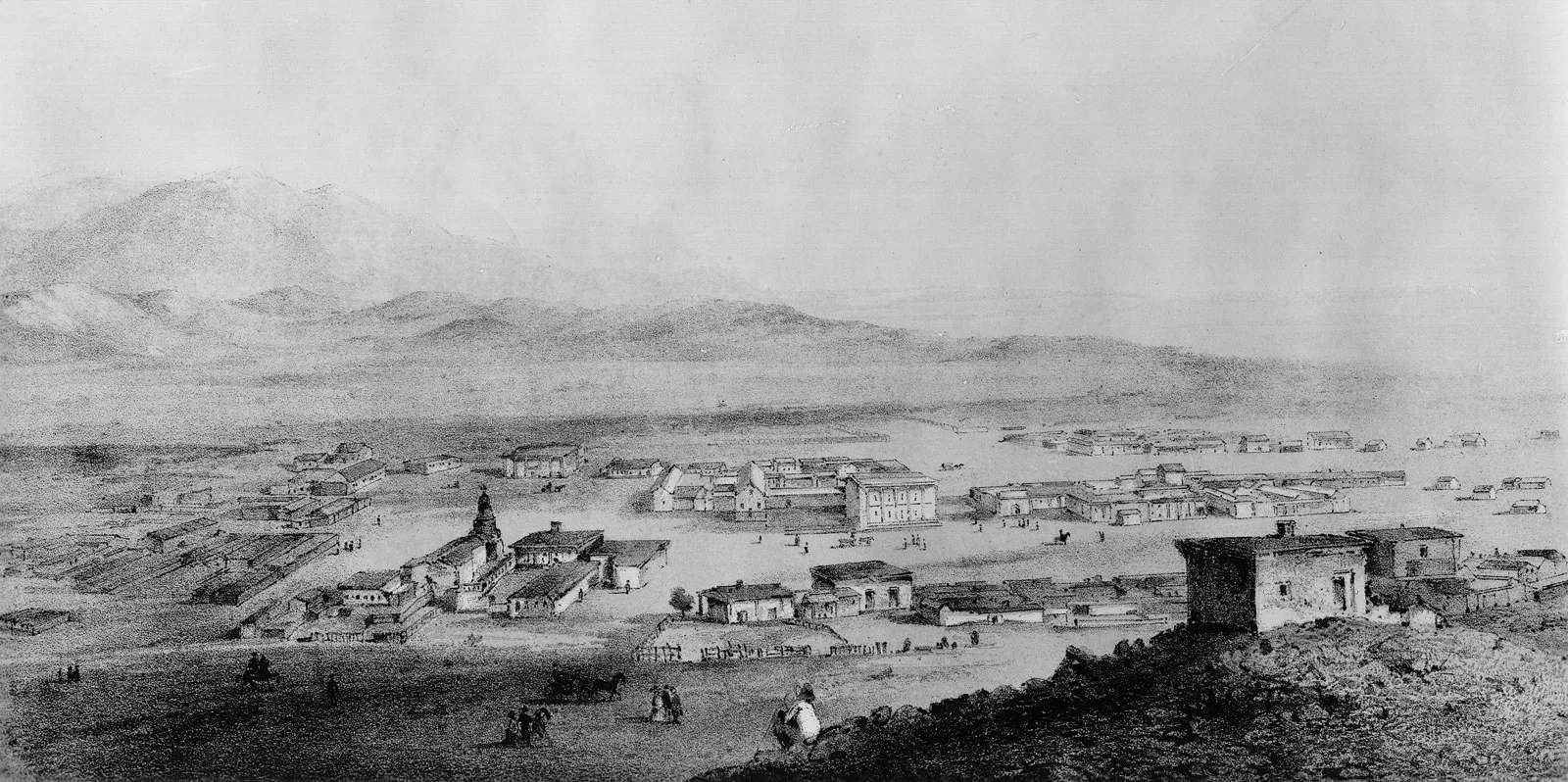
When American forces arrived in 1846, Los Angeles was a modest settlement of approximately 1,500 residents, far removed from the centers of Mexican power. The pueblo had been founded in 1781 as a Spanish colonial outpost, but by the mid-nineteenth century it existed as a sleepy ranching community where vast cattle operations dominated the landscape. The californios—the Mexican and Spanish settlers who controlled the region—had developed a distinct culture centered on horseback riding, cattle ranching, and land ownership through generous Mexican land grants.
The pueblo’s architecture reflected its Spanish and Mexican heritage, with single-story adobe structures surrounding a central plaza where the church stood as the community’s spiritual and social nucleus. Dirt roads connected scattered ranches where wealthy families like the Picos, Sepúlvedas, and Avilas presided over thousands of acres. These families represented the aristocracy of Mexican California, living lives of relative comfort based on hide and tallow trade with American and European ships.
Despite this seeming tranquility, Los Angeles in the 1840s was politically unstable. Mexico itself was wracked by internal conflicts, and California existed at the far periphery of Mexican authority. Governors came and went, sometimes violently. Local leaders feuded over power and resources. This political vacuum would prove crucial when American forces arrived, as divided californio leadership struggled to mount effective resistance.
The American Military Conquest
The Mexican-American War brought profound changes to California. In July 1846, Commodore John D. Sloat raised the American flag in Monterey, claiming California for the United States. Los Angeles, however, would not submit so easily. When Commodore Robert Stockton arrived to occupy Los Angeles in August 1846, initial resistance seemed minimal. The californios appeared to accept American rule, at least temporarily.
This acceptance was illusory. In September 1846, californio forces under José María Flores rebelled against American occupation, forcing American troops to withdraw from Los Angeles. For several months, the californios controlled the pueblo once again, representing the last significant Mexican military control over Alta California. This period demonstrated that while American military superiority was evident, the californios retained considerable martial skill and local knowledge.
The American reconquest came swiftly. In January 1847, Brigadier General Stephen Kearny led forces from New Mexico while Stockton advanced from San Diego. The decisive engagement occurred at the Battle of Rio San Gabriel on January 8, 1847, where American artillery and discipline overwhelmed californio cavalry charges. The following day, another skirmish at La Mesa effectively ended organized californio resistance.
On January 10, 1847, californio leaders signed the Treaty of Cahuenga, formally ending hostilities in California. This treaty, negotiated by John C. Frémont and Andrés Pico, was notably generous to the defeated californios, promising protection of property rights and civil liberties. These promises would prove difficult to keep as American settlement intensified.
The Treaty of Guadalupe Hidalgo and Legal Transformation
The formal transfer of California to the United States came with the Treaty of Guadalupe Hidalgo in February 1848, which ended the Mexican-American War. This treaty ceded vast territories to the United States, including all of California. For Los Angeles, the treaty’s significance extended beyond sovereignty. It supposedly guaranteed property rights and citizenship to Mexican residents who chose to remain in the newly American territory.
Article VIII of the treaty promised that Mexicans in the ceded territories could choose to retain Mexican citizenship or become American citizens, and that their property rights would be “inviolably respected.” Article IX guaranteed civil and political rights to those who became American citizens. These provisions seemed to protect the californio elite who controlled most of the valuable land around Los Angeles.
Reality proved far more complex. While the treaty offered protections on paper, its implementation depended on American courts, American officials, and American interpretations of Mexican land law. The californios would soon discover that legal promises meant little against the tide of American migration and the prejudices of the arriving population.
The establishment of American legal and political institutions happened rapidly. In 1850, California achieved statehood—bypassing the usual territorial period—largely due to the Gold Rush population explosion in northern California. Los Angeles became the county seat of the newly formed Los Angeles County. American legal codes replaced Mexican law, though determining how American law would treat existing Mexican land grants remained contentious.
The Land Grant Controversy
The most consequential legal battle in early American Los Angeles centered on Mexican land grants. Under Mexican rule, wealthy californios had received enormous ranchos, sometimes encompassing tens of thousands of acres. These grants were often poorly surveyed, based on informal boundaries, and documented inadequately by American legal standards. When American land law arrived, it demanded precise surveys, clear titles, and documentary proof that many californio families struggled to provide.
The Land Act of 1851 established a commission to review all land grant claims in California. This seemingly reasonable measure placed the burden of proof on the claimants—the californio landowners—to demonstrate valid title. The process required expensive legal representation, often dragged on for years, and demanded documentation that many families had never maintained. Even when claims succeeded, the legal fees frequently forced families to sell portions of their land to pay their lawyers.
Consider the case of the vast Rancho San Pedro, granted to Juan José Domínguez in 1784 and confirmed under Mexican rule. The Domínguez family spent years and thousands of dollars proving their claim before American courts. They ultimately retained their land, but many neighboring families were less fortunate. The process favored American lawyers, surveyors, and speculators who understood the new legal system and had capital to invest while claims remained uncertain.
Squatters complicated matters further. American settlers, believing that Mexican land grants were illegitimate or that californio families didn’t deserve such vast holdings, simply occupied land and dared owners to remove them. Evicting squatters required legal action in American courts, adding more costs for californio families. Some squatters won rights to land they had “improved,” further diminishing californio holdings.
The Gold Rush and Its Impact
While the 1849 Gold Rush centered on northern California, its effects rippled through Los Angeles. The pueblo became a supply point and stopping place for miners heading north. More significantly, the Gold Rush transformed California’s economy and demography almost overnight. Between 1848 and 1852, California’s population exploded from approximately 15,000 to over 250,000. Most newcomers were Americans from the East Coast or Midwest, fundamentally altering the cultural balance.
Los Angeles initially struggled to capitalize on Gold Rush prosperity. The pueblo remained relatively small, growing to only about 2,500 residents by 1852. San Francisco, positioned near the goldfields, became California’s commercial hub. Los Angeles seemed destined to remain a backwater, isolated from the main currents of California development.
However, the Gold Rush created markets for beef and agricultural products that Los Angeles could supply. Cattle prices soared as miners needed food. Southern California ranchers drove herds north to feed hungry prospectors, generating substantial profits. This boom was temporary—by the mid-1850s, cattle prices collapsed as supply overwhelmed demand—but it briefly enriched some californio and American ranchers alike.
The Gold Rush also brought social disruption. Racial tensions intensified as Anglo-American miners, accustomed to viewing Mexicans and other non-whites as inferior, arrived in California. Los Angeles saw increasing friction between californios and newly arrived Americans. Violence became commonplace, with both vigilante justice and organized mob actions targeting californios and other non-Anglo residents.
Building American Institutions
The Americanization of Los Angeles required creating institutions from scratch or transforming existing Mexican structures. In 1850, Los Angeles received its first American-style city government with an elected mayor and council. Initially, californio elites participated actively in this government, with men like Antonio Coronel serving in various official capacities. This participation suggested a potential path toward genuine bicultural governance.
That promise faded as American immigration continued. By the late 1850s, Anglo-Americans increasingly dominated city government. Language barriers, different political traditions, and outright prejudice marginalized californio participation. Elections that had once balanced californio and American interests became dominated by the growing American majority.
The establishment of an American legal system brought profound changes. The first American lawyers arrived in the early 1850s, opening practices and quickly becoming influential. They understood American property law, spoke English fluently, and had connections to power structures that californios lacked. Courts conducted proceedings in English, disadvantaging Spanish-speaking residents who needed translators to navigate their own legal matters.
Education reflected American dominance. Spanish-language schools that had operated under Mexican rule gradually gave way to English-language institutions. The Catholic Church, which had served as the primary educational institution, found itself supplemented and eventually superseded by public schools teaching in English and emphasizing American history and values. Children of californio families increasingly learned that their heritage was being relegated to the past.
The Great Drought and Economic Transformation
The severe drought of 1862-1865 delivered a catastrophic blow to the rancho economy and accelerated Los Angeles’s transformation into an American city. After years of relatively good rainfall, the drought withered pastures across Southern California. Cattle that had numbered in the hundreds of thousands died by the tens of thousands. Ranchers who had survived legal challenges to their land grants found themselves unable to pay taxes or debts as their herds perished.
This disaster forced massive land sales. American speculators with capital purchased rancho land at depressed prices from desperate californio families. Vast estates were subdivided and sold to incoming American farmers who practiced different agriculture—wheat cultivation rather than cattle ranching. The physical landscape began changing as plowed fields replaced open range, fundamentally altering Southern California’s appearance and economy.
The drought coincided with the end of the Civil War, which released a new wave of American migration westward. Veterans from both Union and Confederate armies sought fresh starts in California. These newcomers had little connection to or sympathy for the californio past. They came to build American communities according to American models, and Los Angeles offered the opportunity.
By the late 1860s, Los Angeles was unmistakably American in character, though the city retained Hispanic influences in architecture, place names, and cultural practices. The pueblo plaza, once the center of californio life, increasingly served a diverse population where English dominated public discourse. American businesses lined streets with English-language signs. The physical fabric of the city was changing too, as wooden American-style buildings began replacing traditional adobe structures.
The Railroad Era and Urban Expansion
The completion of the transcontinental railroad in 1869 and the subsequent arrival of rail connections to Los Angeles fundamentally transformed the city’s trajectory. In 1876, the Southern Pacific Railroad reached Los Angeles, finally connecting the isolated pueblo to national markets and transportation networks. This connection accelerated every trend toward Americanization.
The railroad brought an unprecedented influx of American settlers. Real estate developers recognized Los Angeles’s potential, particularly its mild climate, which they marketed aggressively to Easterners and Midwesterners tired of harsh winters. The population began growing rapidly, from approximately 5,700 in 1870 to over 11,000 by 1880. This growth was almost entirely American, further diluting californio influence.
Transportation changes also reshaped the physical city. Los Angeles expanded beyond its original pueblo boundaries as subdivisions spread across former rancho lands. American urban planning principles guided this expansion, with grid patterns, surveyed lots, and property deeds that reflected Anglo-American concepts of land ownership. The informal, flexible boundaries of Mexican California gave way to precise legal descriptions and recorded plats.
Economic diversification accompanied urban growth. While agriculture remained important, Los Angeles developed manufacturing, commerce, and service industries serving a growing urban population. American entrepreneurs established businesses ranging from foundries to furniture factories. Banking institutions provided capital for development, operating according to American financial practices that californios often found alien and disadvantageous.
Cultural Displacement and Memory
The transformation of Los Angeles from Mexican pueblo to American city came at tremendous cost to the californio population. By the 1880s, most californio families had lost their land, their political power, and much of their cultural influence. Some families maintained wealth by adapting to American economic practices, but many descended into poverty as their ranchos were subdivided and sold.
Cultural displacement extended beyond economics. The Spanish language retreated from public spaces. Mexican cultural practices survived primarily in private, within families and small community gatherings rather than as dominant public expressions. American cultural norms—from clothing styles to entertainment to social customs—became hegemonic in Los Angeles.
Yet erasure was never complete. Place names retained Spanish heritage: Los Angeles itself, along with streets and neighborhoods bearing Spanish names, created a linguistic landscape that acknowledged Mexican roots even as the city became thoroughly American. Missions and some adobe structures survived as monuments to the Spanish and Mexican past, though often reinterpreted through romantic American nostalgia rather than accurate historical memory.
Some californio families maintained influence by intermarrying with wealthy American arrivals or by successfully navigating the new economic order. These families served as bridges between cultures, though often at the cost of partially abandoning their heritage to succeed in an American-dominated society. Their experiences illustrated the complex process of cultural adaptation and survival under conquest.
The Founding Myth and Historical Interpretation
As Los Angeles grew into a major American city in the late nineteenth and early twentieth centuries, its founding narrative underwent revision. American boosters preferred to emphasize Anglo-American contributions while romanticizing the Spanish past. The Mexican period was often ignored or deprecated as a lazy, inefficient interlude between Spanish colonization and American progress.
This interpretation served ideological purposes. By positioning American settlement as the true founding of Los Angeles as a significant city, boosters justified conquest and displacement. The californios were cast as colorful figures from a picturesque past rather than as people who had been systematically dispossessed through legal manipulation, economic pressure, and discrimination.
The reality was more complex and less flattering to American triumphalism. The founding of Los Angeles as an American city involved conquest, both military and legal. It involved the imposition of foreign legal systems on existing property arrangements. It involved demographic overwhelming of the existing population through encouraged migration. These processes were neither inevitable nor entirely peaceful, though they are often portrayed that way in simplified historical narratives.
Modern historians have worked to complicate and enrich our understanding of this transition period. Rather than seeing a simple progression from Mexican inefficiency to American dynamism, scholars now recognize the californios as sophisticated actors who struggled to maintain their status under extraordinarily difficult circumstances. The legal battles over land grants reveal not californio ignorance but American manipulation of legal processes to facilitate land transfer.
Legacy and Lasting Impact
The founding of Los Angeles as an American city established patterns that shaped Southern California’s development for generations. The dispossession of californio landowners enabled American real estate development on an massive scale. The subdivision of vast ranchos into smaller parcels made possible the sprawling suburban development that would characterize twentieth-century Los Angeles.
The cultural displacement of the Mexican population created a city where Hispanic heritage was simultaneously celebrated in superficial ways—mission architecture, place names, cultural festivals—while actual Mexican and Mexican-American residents faced discrimination and marginalization. This contradiction would persist through the twentieth century, complicating Los Angeles’s relationship with its Mexican past and present.
The legal precedents established during the land grant controversies had lasting implications. The principle that existing property rights could be subjected to new legal scrutiny and potentially invalidated based on documentation requirements set important precedents. The use of legal processes to transfer land from one group to another would recur throughout American history, applied to Native American lands, Mexican holdings, and other cases where conquest was legalized through courts rather than accomplished purely through military force.