

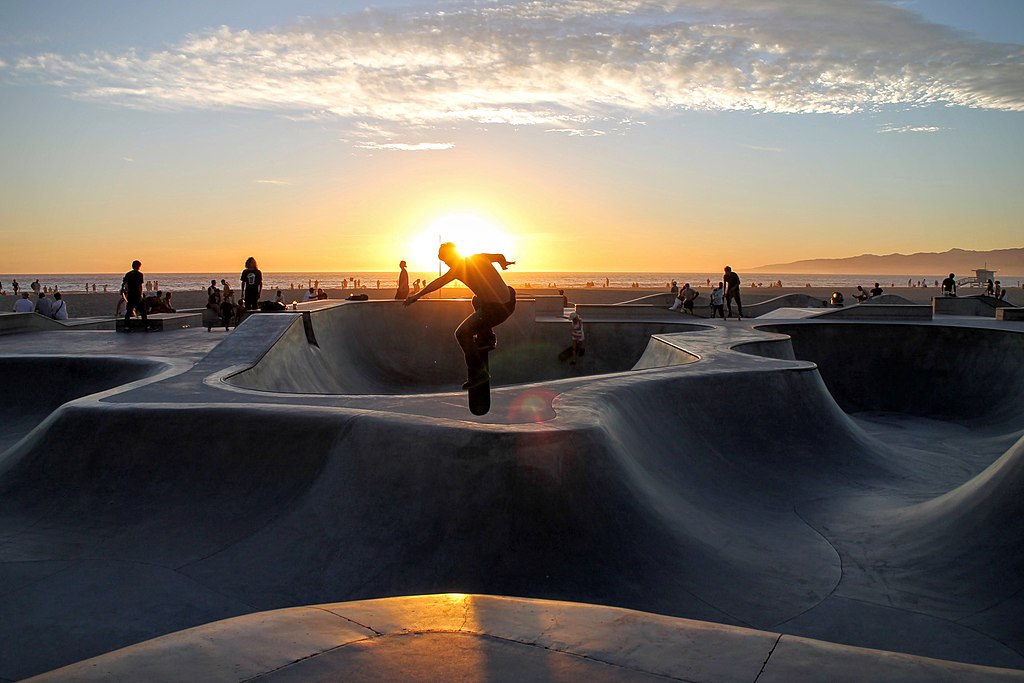
The sun hasn’t fully crept over the horizon when the first wheels hit the concrete at Venice Beach Skatepark. By 6 AM, a dozen skaters are already carving through the bowls, their movements fluid and instinctive, as if the park itself is breathing through them. This isn’t just morning exercise. This is ritual, religion, and rebellion all ground into a single slab of skateable terrain that has defined counterculture for more than half a century.
Venice Beach didn’t invent skateboarding, but it might as well have. What started as sidewalk surfing in the 1950s exploded into a full-blown cultural movement along these California shores, transforming a children’s toy into an art form, a sport, and a lifestyle that would spread across every continent. The story of Venice skate culture is the story of American youth finding expression in the most unlikely places, of outsiders creating their own rules, and of concrete becoming canvas.
The Birthplace of Vertical Dreams
Before there were skateparks, there were swimming pools. In the mid-1970s, California faced a devastating drought that left thousands of backyard pools empty. The Z-Boys, a crew of young surfers and skaters from the Dogtown area of Santa Monica and Venice, saw opportunity where others saw crisis. They began trespassing into empty pools, translating surf moves onto vertical concrete walls, and in doing so, they invented modern skateboarding.
Tony Alva, Stacy Peralta, Jay Adams—these names became legend not in corporate boardrooms or mainstream sports arenas, but in stolen moments of creativity inside drained pools. They developed aerials, grabbed their boards mid-flight, and rode walls in ways that defied both gravity and convention. The raw aggression and artistic innovation of these sessions would define skateboarding’s aesthetic for decades to come.
The Dogtown era wasn’t just about tricks. It was about attitude. These kids came from broken homes and rough neighborhoods. Skateboarding gave them identity, community, and a way to transform pain into power. The style they developed—low, aggressive, surf-influenced—became the template. Their approach to life—fearless, anti-establishment, creative—became skateboarding’s ethos.
The Venice Pavilion Era
By the 1980s, Venice had its first legitimate skatepark. The Venice Pavilion wasn’t particularly well-designed by today’s standards, but it was theirs. Locals defended it fiercely from outsiders, establishing a territorial pecking order that persists in various forms today. If you couldn’t handle the intensity, the heckling, or the level of skating, you didn’t belong.
This era saw the rise of Venice skate gangs—not criminal organizations in the traditional sense, but tight-knit crews that controlled spots, influenced style, and created their own social hierarchy. The Venice Suicidals, among others, became known not just for their skating ability but for their fierce protection of local turf. Skateboarding wasn’t just recreation; it was territory, identity, and sometimes survival.
The rough edges weren’t incidental. Venice itself was rough. The boardwalk attracted everyone from street performers to drug dealers, from bodybuilders at Muscle Beach to homeless encampments. Skating here meant navigating a complex urban ecosystem where mainstream rules didn’t always apply. The skaters fit right in—outsiders in a community of outsiders, creating beauty in a landscape others might consider broken.
Architecture of Rebellion
The current Venice Skatepark, which opened in 2009, represents something of a miracle—a city-sanctioned space that maintains the raw energy of outlaw skating while providing legitimate access. Designed with significant input from local skaters, the 16,000-square-foot park features bowls, a snake run, and street elements that flow together in a way that encourages creativity rather than constraining it.
The design philosophy matters. Unlike corporate skateparks that prioritize safety and uniformity, Venice was built to reward skill, courage, and innovation. The deep end of the main bowl sits at nine feet, with unforgiving pool coping that punishes hesitation. The transitions are steep, the lines endless, and the margin for error slim. This isn’t a park where beginners comfortably learn—it’s where competent skaters become great ones.
But the physical space is only part of the story. The invisible architecture—the social codes, the hierarchy, the unwritten rules—shapes the experience as much as the concrete. Dropping in at the wrong time can earn you a verbal lashing. Snaking someone’s line is grounds for confrontation. Respect is earned through skill, consistency, and understanding that you’re entering a space with history that predates your presence.
The Session as Sacred Space
Watch a session at Venice for an hour and you’ll witness something that looks chaotic to outsiders but operates on precise internal logic. Skaters rotate through runs with an informal but strictly observed order. The best skaters don’t always go first—sometimes they wait, watch, and then raise the bar with a line that redefines what’s possible. Younger skaters learn by observing these dynamics, understanding that talent alone doesn’t grant status; you need awareness, timing, and respect for the collective flow.
The sound creates its own rhythm. Wheels on concrete produce a particular grinding hum that changes pitch with speed and surface. Trucks grinding coping create metallic screams. The pop of a board off the ground serves as percussion. Then there’s the human element—the calls of encouragement, the groans of near-misses, the eruptions when someone lands something extraordinary. It’s a symphony written in urethane and concrete, performed daily by rotating casts who nonetheless follow the same unwritten score.
Style Over Everything
Technical ability matters at Venice, but style matters more. You can land every trick in your arsenal and still be dismissed if you skate without personality, without that ineffable quality that separates mechanical execution from genuine expression. The most respected skaters make difficult tricks look effortless, their bodies relaxed even when pulling g-forces in a bowl’s deep end.
This emphasis on style connects directly to Venice’s surf heritage. Just as the best surfers make riding massive waves look like a casual afternoon activity, the best Venice skaters approach nine-foot bowls with a similar casual mastery. Stiffness indicates fear or uncertainty. Fluidity indicates complete control. The goal isn’t just to complete tricks but to flow through them in a way that appears spontaneous, even when it’s the product of thousands of hours of practice.
Fashion follows function but also makes statements. Vans shoes remain the unofficial uniform, though newer brands have made inroads. Dickies work pants offer durability and a nod to working-class roots. Oversized shirts provide freedom of movement and a deliberate rejection of athletic wear’s sleek efficiency. The aesthetic is deliberately rough around the edges, a middle finger to mainstream sports culture’s polish and commercialization.
The Paradox of Professionalization
Skateboarding’s journey from outlaw activity to Olympic sport has created tension in Venice’s scene. The 2020 Tokyo Olympics (held in 2021) featured skateboarding for the first time, lending institutional legitimacy to an activity that built its identity on rejecting institutions. Young skaters now train in facilities that would have been unthinkable thirty years ago, with coaches, sponsorships, and career paths that resemble traditional athletics.
Yet Venice remains stubbornly uncommercial in spirit if not in reality. Yes, camera crews occasionally descend to film promotional content. Yes, professional skaters treat the park as a training ground. But the core session—the daily gathering of locals who skate because they have to, not because they’re getting paid—maintains the original energy. The professionals who command genuine respect are those who remember where they came from and don’t let sponsorship money change how they interact with the community.
The reality is that skateboarding has always existed in this tension. Even in the 1970s, the most talented Dogtown skaters were getting sponsored by surf shops and emerging skate companies. The difference was scale, not principle. What Venice skaters resist isn’t compensation for skill but the sanitization of skateboarding’s rough edges in pursuit of mainstream acceptance. They’ll take the money, but they won’t soften the attitude.
Gatekeeping or Preservation?
The locals-versus-tourists dynamic at Venice generates endless debate. Visitors complain about hostile locals who make them feel unwelcome. Locals counter that their protectiveness preserves the park’s character and prevents it from becoming a tourist attraction where actual skating becomes secondary to photo opportunities and casual dabbling.
Both perspectives hold truth. Venice Skatepark is a public facility paid for with public money, theoretically open to everyone regardless of skill level or origin. At the same time, the locals have maintained the culture that makes the park special. Their daily presence, their willingness to push boundaries, and yes, their territorial protection of the space create the energy that draws people from around the world. Without them, it would be just another skatepark.
The unspoken compromise works like this: Show up with genuine respect and appropriate skill, and you’ll be accepted. Roll in with an entitled attitude or equipment that’s clearly never been used, expect resistance. Take a photo or two, fine. Set up a tripod for an Instagram photoshoot while serious skaters wait for you to clear the line, prepare for verbal feedback. The rules aren’t codified, but they’re consistent.
Women in the Bowl
Historically, Venice skate culture was aggressively masculine, and that created real barriers for women and girls who wanted to participate. The atmosphere could be actively hostile, the comments crude, the assumption being that women didn’t belong in the bowl. This reality shaped generations of skateboarding, limiting who felt welcome and who could develop their skills in the sport’s most legendary spaces.
That landscape has shifted significantly in recent years, though not without ongoing challenges. More women are skating at Venice than ever before, and the best among them command the same respect as their male counterparts. When a woman drops into the deep end and carves clean lines, the response from knowledgeable skaters is appreciation for the skill, period. The Olympic exposure, featuring women’s competitions alongside men’s, has helped normalize female presence in skateboarding’s upper echelons.
But progress isn’t uniform. Women still face comments and assumptions that men don’t. The protective gatekeeping that locals apply to tourists and beginners can feel especially intense for women navigating a space that has been predominantly male for decades. The solution, as many female skaters demonstrate daily, is the same one that’s always worked at Venice: be undeniably good. Skill transcends other categories and earns respect even from the most skeptical observers.
The Boardwalk Laboratory
Venice Skatepark doesn’t exist in isolation from its surrounding environment. The adjacent boardwalk serves as an extended laboratory for street skating, with rails, stairs, and ledges that skaters have been sessioning for decades. This proximity between park and street creates a unique dynamic where skaters can flow between different styles, different challenges, and different communities within minutes.
The street skating scene operates on slightly different principles than the park. There’s less territorial control and more guerrilla creativity. A good street spot might get blown out—ruined by security, hostile architecture, or city intervention—forcing skaters to constantly scout new locations. This impermanence breeds a different mentality: hit it now, hit it hard, and move on before someone stops you.
The diversity of the boardwalk population influences the skating. Street performers, vendors, tourists, and residents all share the space, creating unpredictable obstacles and opportunities. A skater might have to navigate around a drum circle, wait for a tourist family to clear from a stair set, or time a trick between police patrols. This chaos breeds adaptability and quick thinking that translates into better overall skating.
Digital Age, Analog Soul
Social media has transformed how skate culture propagates and documents itself. A trick landed at Venice can circulate globally within hours, inspiring skaters thousands of miles away and occasionally making overnight celebrities of previously unknown rippers. This democratization of exposure has positive aspects—talented skaters from any background can build followings without industry gatekeepers deciding who’s marketable.
But the digital age also creates distortions. Skating for content creation differs from skating for personal progression or pure enjoyment. The pressure to constantly produce sharable material can transform sessions into performances, where the goal shifts from exploring what’s possible to capturing what’s viral. Some of the best skating happens when cameras aren’t rolling, when skaters are trying ridiculous things that might not work but push their understanding of what they can do.
Venice’s core session remains relatively resistant to these digital pressures. The daily locals skate because they need to, not because they’re building a brand. They appreciate good filming when it happens but don’t organize their entire approach around it. This creates an interesting split: the Instagrammable version of Venice skate culture exists alongside the lived reality, sometimes overlapping but often quite distinct.
The Next Generation
Kids who grow up skating Venice today inherit a legacy they may not fully understand. They’re riding the same concrete that legends have ridden, surrounded by echoes of innovation that shaped global skateboarding. Some rise to that challenge, studying video of classic runs, talking with older skaters who remember previous eras, and consciously trying to add their own chapter to the ongoing story.
Others treat it as just another skatepark, albeit a really good one. They’re not wrong—the present matters more than the past, and skating should be about immediate experience rather than historical burden. But something gets lost when skaters don’t understand the battles fought to create and preserve the space they’re enjoying, the evolution of tricks they’re now learning as basics, or the cultural significance of what might seem like just a fun afternoon activity.
The best outcome is probably a balance: respect the history without being trapped by it, honor the pioneers while pushing beyond what they thought possible, maintain the core values while remaining open to evolution. That’s easier to describe than to achieve, but Venice skate culture has always excelled at impossible things.
Concrete Permanence in Impermanent Times
Venice Beach itself faces constant pressure from gentrification, rising property values, and the displacement that follows wealth into previously rough neighborhoods. The area that birthed Dogtown skateboarding because it was overlooked and undervalued now attracts tech money, luxury developments, and the kind of sanitization that typically erases grittier cultural elements.
Yet the skatepark endures, a concrete monument to cultural values that resist commercialization and gentrification. You can’t price out skaters when they just need a board and the willingness to risk injury. You can’t gentrify a culture built on rejecting mainstream approval. The very permanence of the concrete makes a statement: this space is claimed, this culture is rooted, and it won’t be easily displaced by economic forces that have erased other elements of Venice’s character.
The skatepark serves as a kind of cultural anchor, a reminder that Venice is more than million-dollar condos and artisanal coffee shops. It maintains a connection to the area’s outlaw past, its working-class roots, and its tradition of creative resistance. As long as skaters are dropping into that bowl at dawn, Venice retains at least some of its soul.
Why It Still Matters
In an era of increasing digital mediation, climate-controlled environments, and risk-averse parenting, skateboarding at Venice represents something increasingly rare: unfiltered physical challenge, genuine risk, and culture created from the ground up by participants rather than consumers. You can’t fake your way through the deep end. You can’t buy respect. You can’t hire someone else to do it for you.
This authenticity attracts people who feel alienated by mainstream culture’s superficiality. Skateboarding requires real skill developed through real practice involving real failure and real pain. The community judges you based on what you can actually do, not who you know or what you can afford. In a world where so much is mediated, monetized, and manipulated, this directness has profound appeal.
The creative dimension matters too. Unlike sports with fixed rules and standardized objectives, skateboarding rewards individual interpretation. Two skaters can approach the same bowl completely differently, both excellently. The best skaters don’t just execute tricks; they create lines, develop personal styles, and find new ways to interact with familiar terrain. It’s athletic performance and artistic expression simultaneously, physical and creative challenge merged into single runs measured in seconds but representing hours of experimentation.
Venice skate culture, at its core, represents human creativity refusing to be constrained by limitations others accept as inevitable. Those Z-Boys didn’t see empty pools; they saw potential. Modern Venice skaters don’t see a public park with rules and regulations; they see an ongoing laboratory for pushing boundaries. This mindset—seeing possibility where others see obstacles—extends far beyond skateboarding and represents one of humanity’s essential characteristics: the drive to transcend, to create, to make something beautiful out of whatever materials we’re given.
The concrete at Venice Beach Skatepark will eventually crack, get repaired, and crack again. Skaters will keep riding it, keep pushing what’s possible, keep creating culture from the ground up. The specifics will change—tricks will evolve, styles will shift, new generations will bring fresh perspectives. But the essential spirit, forged in drought-emptied pools half a century ago, remains as constant as the Pacific waves that first inspired someone to put wheels on a board and try riding concrete like water.
That’s the real legacy of Venice skate culture: not any particular trick or skater, but the ongoing demonstration that the human need for creative expression finds a way, that community forms around shared challenges, and that meaning can be carved into concrete through nothing more than persistence, courage, and the willingness to fall down and get back up. Every session adds another layer to that legacy. Every dropped-in run connects to decades of previous runs. Every kid learning to pump the transitions inherits something more valuable than technique—they inherit the knowledge that the world can be shaped by those brave enough to try.